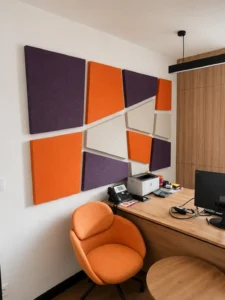
“Absorption vs. Sound Masking vs. Screens: Which Actually Fixes Office Noise?”

Absorption vs. Sound Masking vs. Screens: Which Actually Fixes Office Noise?
None of the three on its own reliably fixes office noise. Absorption (ceiling and wall treatment) shortens reverberation and reduces how far reflected sound carries; screens and partitions block a direct line of sight and add a physical barrier; sound masking (45–48 dBA of engineered background sound) covers residual speech so it drops below intelligibility sooner. Most real complaints — distraction, overheard confidential conversations, “muddy” meeting rooms — are caused by a combination of all three failure modes, so the reliable fix layers all three levers in sequence: absorb first, block second, cover third. This is the “ABC rule” we use on nearly every open-plan office survey, and understanding which letter addresses which symptom is the difference between a project that actually resolves complaints and one that just moves the budget around without moving the numbers.
In our site surveys, we see the same mistake constantly: a facility team buys a truckload of desk screens because that’s the product every catalog pushes, or installs sound masking because a vendor promised it “eliminates noise,” and neither move touches the actual measured problem. This article walks through what each lever does, what it categorically cannot do, typical cost and disruption, and the order that produces a genuinely quieter office rather than a more expensive one.
The three levers, in one sentence each
- Absorb — ceiling and wall treatment that removes sound energy from the room, shortening reverberation time (RT60) and reducing how far reflected speech travels.
- Block — screens, partitions, and enclosed rooms that interrupt the direct and reflected sound path between a talker and a listener.
- Cover — engineered sound masking that raises the room’s background noise floor so residual speech becomes unintelligible at a shorter distance.
These map directly onto the three physical ways speech reaches an unwanted listener: it travels straight to them (blocked by a barrier), it reflects off hard surfaces and reaches them indirectly (reduced by absorption), or it reaches them at a low enough level that only a quiet room lets it stay intelligible (masked by raising the noise floor). If you understand this, the rest of the comparison is mostly mechanics.
We’ve covered the underlying ISO 3382-3 metrics — D2,S, distraction distance, and privacy distance — and why open-plan offices are inherently distracting in earlier articles. This one is specifically about comparing the fixes.

Lever 1 — Absorb: ceiling and wall treatment
How it works
Every hard, parallel, reflective surface in a room — bare ceilings, glass partitions, drywall, hard flooring — bounces sound back into the space instead of removing it. Absorptive material (mineral wool, acoustic foam, PET felt, fabric-wrapped panels) converts some of that sound energy into heat through friction inside the material, so less energy remains to reflect. The measurable result is a shorter reverberation time, calculated with the Sabine formula: RT60 = 0.161 × V / A, where V is room volume in m³ and A is total absorption in metric sabins (surface area × absorption coefficient, summed across all surfaces). More absorption (higher A) means a shorter RT60 for the same room volume.
A material’s absorptive performance is rated by its NRC (Noise Reduction Coefficient) — the arithmetic average of absorption coefficients at 250, 500, 1000, and 2000 Hz, rounded to the nearest 0.05, tested per ASTM C423. An NRC of 0.85 absorbs roughly 85% of mid-frequency sound striking it; NRC 0.00 is fully reflective. We go into this rating system, and its finer alternative SAA, in detail in our article comparing NRC and the raw absorption coefficient.
What it solves
- Long reverberation tails that make speech and meetings sound “muddy” or hard to follow — see what RT60 actually measures.
- Reflected sound energy that extends the distance at which speech is intelligible — improving D2,S (spatial decay rate) and shortening distraction distance rD.
- Poor call quality on video calls, where a laptop microphone picks up reflections as much as direct voice — a problem we cover in detail in our article on office speech privacy for video calls.
- General “noisy, echoey, tiring” room complaints in open offices, conference rooms, and call centers.
What it does NOT solve
Absorption reduces reflected energy inside the room it’s installed in — it does nothing to a direct line of sight between two nearby desks, and it does nothing to stop sound passing through a wall, floor, or door into the next room. A perfectly absorptive ceiling will not give a private phone booth confidentiality if the booth’s own walls are a stud partition with gaps at the top — that is a sound-insulation problem, not an absorption problem. We explain this distinction, which trips up more facility teams than any other acoustic concept, in our article on absorption vs. soundproofing and in the related comparison of NRC vs. STC — a material can have excellent NRC and near-zero sound-blocking ability at the same time.
Absorption also cannot compensate for two desks with no separation and no masking sitting 2 meters apart — it shortens how far reflected sound travels, but it cannot suppress the direct path of a conversational voice at close range.
Typical cost and disruption
Ceiling absorption (rafts, baffles, or a full acoustic ceiling) is usually the most cost-effective square-meter treatment and can often be installed with minimal disruption to daily work — after-hours or zone-by-zone installation is common, and no structural changes are required in a typical retrofit. Wall panels add incremental cost per surface treated. Because it’s a surface-applied product, it is generally the least disruptive and lowest-cost of the three levers to retrofit into an occupied office. See our ceiling vs. wall acoustic treatment comparison for how we typically split budget between the two.
Best-fit scenario
Rooms with a measured RT60 above the target range for speech (0.4–0.7 s for private offices, open offices, and meeting rooms) or a poor D2,S reading. This is usually step one on almost every project we run, because most untreated commercial interiors are far more reflective than they need to be, and every other lever performs better once reflected energy is under control.
Lever 2 — Block: screens and partitions
How it works
A screen, partition, or wall interrupts the direct path between a talker and a listener, either by absorbing/reflecting sound at the barrier itself (desk screens, freestanding partitions) or by providing genuine mass and an airtight seal that resists sound transmission (a real partition wall or enclosed room). These are not the same thing, and this is the single most misunderstood distinction in this lever.
A fabric-wrapped desk screen mostly interrupts line of sight and adds modest attenuation to the direct path — it reduces, rather than eliminates, the sound reaching the next desk, and it does very little for sound diffracting over the top or reflecting off the ceiling above it. A genuine partition wall, by contrast, is rated for airborne sound transmission and, properly installed with a sealed perimeter, can achieve real isolation between two spaces. We compare these two categories of “block” directly in our article on movable partitions vs. fixed walls, and our movable partition wall service page covers the specification detail for the higher-performance option.
What it solves
- Direct-path speech and line-of-sight distraction between adjacent desks (desk screens, low partitions).
- Genuine acoustic separation between zones or rooms that need real privacy — focus rooms, phone booths, meeting rooms — when built as a proper partition with a sealed door, not just a screen (real partitions and acoustic doors).
- Flexible zoning in offices that need to reconfigure layouts periodically, where a movable partition avoids the cost of a fixed wall.
What it does NOT solve
A desk screen does not stop sound reflecting off a hard ceiling and arriving at the next desk from above — this is why screens alone frequently underperform expectations; the room’s reflected energy simply routes around the barrier. Screens also do nothing for reverberation time measured across the whole room. And even a genuine partition wall only blocks what its construction — mass, seal, and any penetrations — actually allows; a well-built wall with an unsealed door undercut, or gaps above a suspended ceiling, will leak most of the isolation the wall itself provides. We detail this “weakest link” effect in our article on acoustic doors as the weak link in a wall system, and the broader distinction between sound passing through a partition versus a footstep or impact is covered in airborne vs. impact noise.
Typical cost and disruption
Desk screens and freestanding partitions are low-cost and effectively zero-disruption — they can be added or moved without construction work. A genuine acoustic partition wall or enclosed room is a materially bigger investment involving construction, sealing detail, and often a door and ceiling penetration to close, but a movable partition system reduces both the cost and disruption of that step versus a fixed masonry wall, while still delivering real, rated isolation. This is the tradeoff we walk clients through on our movable partition wall page.
Best-fit scenario
Adjacent-desk distraction (screens) or a genuine need to enclose a space for privacy, video calls, or a different noise profile (real partitions, phone booths, focus rooms). Screens are a cheap first move for line-of-sight distraction; a proper partition is the only lever on this list that can create real privacy where distance and masking cannot.

Lever 3 — Cover: sound masking
How it works
Sound masking is engineered, speech-spectrum-shaped background sound delivered through a distributed array of ceiling speakers, calibrated to raise the room’s ambient noise floor to a specific level — typically 45–48 dBA. It does not “cancel” or remove sound; it raises the threshold a listener’s ear (and brain) needs to clear before speech becomes intelligible, so residual leaked speech — whatever absorption and blocking didn’t already remove — drops below intelligibility at a shorter distance. Below roughly 42 dBA, masking has little practical effect; above roughly 50 dBA, occupants perceive it as intrusive HVAC-like noise, and — counterproductively — start talking louder to compensate, which raises the very speech level masking is meant to help control.
What it solves
- Residual speech intelligibility at the margins, after absorption and blocking have already reduced the sound path — masking is the fine-tuning lever, not the primary structural fix.
- Shortening the privacy distance rP (the distance at which STI drops below 0.20) in open-plan zones where a fully enclosed room isn’t practical or affordable for every desk.
- Reducing the perceived intrusiveness of intermittent office sounds (keyboards, footsteps, HVAC cycling) by smoothing out the noise floor.
What it does NOT solve
Masking cannot fix a genuinely reverberant room — a call still sounds “boomy” or reflective to a listener and to a far-end microphone regardless of masking level, because masking addresses intelligibility of other people’s speech, not the acoustic quality of the room a person is speaking in. It also cannot make a wall, screen, or door block more sound than its physical construction allows, and it cannot substitute for genuine enclosure where a real confidentiality requirement exists — HR conversations, legal discussions, healthcare data. Masking that is miscalibrated (too low to matter, or too high to be tolerable) is worse than no masking at all, because occupants notice a “hum” without getting any of the intelligibility benefit.
Typical cost and disruption
Sound masking requires a distributed speaker array above the ceiling (or integrated into ceiling tiles) plus a control system to zone and calibrate levels — moderate cost, moderate disruption if retrofitted above an existing finished ceiling, low disruption if installed during a ceiling renovation alongside absorption. It’s rarely cost-effective as a standalone project; it earns its keep as the last 10–20% of a layered solution.
Best-fit scenario
Open-plan floors that have already had absorption and reasonable zoning/screening applied, but still show a privacy distance that’s longer than the floor layout allows for. Also common in call centers and legal/financial floors where a uniform, low, non-distracting background level is itself a design requirement, independent of any single leak.
Side-by-side comparison
| Lever | Mechanism | Best for | Limits | Relative cost / disruption |
|---|---|---|---|---|
| Absorb (ceiling/wall treatment) | Converts sound energy to heat on contact, reducing reflections and reverberation time (RT60 via Sabine) | Long RT60, “muddy” rooms, poor D2,S, call-quality/microphone pickup | Does not block direct line of sight; does nothing for sound passing through a wall/floor | Low–medium cost, low disruption (surface-applied) |
| Block (screens/partitions) | Interrupts the direct sound path; real partitions add mass and sealed separation | Adjacent-desk distraction (screens); genuine room-to-room privacy (real partitions + doors) | Screens don’t stop sound diffracting over/around them or reflecting off the ceiling; partitions only as good as their weakest seal (door, gaps) | Screens: very low. Real partitions/rooms: medium–high, moderate–high disruption |
| Cover (sound masking) | Raises the ambient noise floor (45–48 dBA) so residual speech becomes unintelligible sooner | Shortening residual privacy distance after absorption/blocking; uniform background level for call-heavy floors | Doesn’t improve room reverberation or call quality; doesn’t create real confidentiality alone; miscalibration backfires | Medium cost, low–medium disruption (ceiling speaker array) |
Why they are complementary, not competing — and the right sequence
Treat this as a stack, not a menu you pick one item from. Each lever removes a specific category of sound energy that the next lever can’t reach on its own, and skipping one usually means over-spending on the others to compensate for a gap they were never designed to close.
1. Absorb first. Reflections inflate every other problem — they extend distraction distance, they degrade call-quality, and they make masking harder to calibrate cleanly (masking a reverberant room just makes a reverberant room slightly louder). Getting RT60 into the target range for the space type is the foundation everything else sits on. This is also usually the cheapest, least disruptive step, which is a practical reason to do it first even before considering cost efficiency.
2. Block second. Once reflected energy is under control, add screening or real partitions where a direct-path or true-privacy problem remains — line-of-sight distraction between desks, or a genuine need for an enclosed room. This step should be sized from the survey data (which desks are actually within the distraction distance of each other), not applied uniformly across the floor.
3. Cover third. Sound masking is the fine-tuning layer that closes the remaining gap — the residual leakage that absorption and blocking couldn’t eliminate cost-effectively. Calibrating masking on a floor that hasn’t had absorption or reasonable screening first usually means running it louder than the comfortable 45–48 dBA range to have any effect, which risks the “intrusive HVAC noise” complaint and people talking louder to compensate.
This sequence isn’t a rigid law — a floor with a genuinely acceptable RT60 but poor screening might start at step two — but it reflects the order in which each lever’s effectiveness depends on the ones before it. We walk through exactly this kind of sequencing, from initial measurement to installed treatment, in our article on taking an office acoustic project from design brief to handover.
Setting realistic expectations
No single lever, and honestly no combination of all three, will make an open-plan office as private as a room with a door — that’s a different design brief entirely (see distraction distance vs. privacy distance for why). What layering absorption, blocking, and masking realistically achieves is: shorter reverberation, fewer nearby-desk distractions, better call quality, and a meaningfully longer distance before speech becomes intelligible to an unintended listener. For genuine confidentiality — legal, HR, healthcare, client financial data — the reliable answer is still an enclosed room with real sound insulation, not an open-plan treatment stack, however well executed.
It’s also worth being honest that these levers interact with layout and behavior, not just materials — the best-treated floor still benefits from sensible zoning (call-heavy desks away from focus areas) and basic etiquette. Treatment reduces the physical problem; it doesn’t remove the need for people to use the space sensibly.

How we approach this on a real project
- Measure first. A site survey establishes current RT60, D2,S, background noise level, and distraction/privacy distances per zone — this is the starting point for our office acoustics service, and it tells you which lever is actually underperforming rather than which one a catalog is pushing.
- Model the absorption fix against the target RT60 range for the space type, sizing ceiling and wall treatment (see ceiling sound insulation where a combined absorption-plus-isolation ceiling build-up is needed) from actual room volume and surface data, not a rule of thumb.
- Map screening and partition needs from the actual desk layout and observed adjacency — which pairs of desks or zones are within distraction distance of each other, and which spaces have a genuine enclosed-privacy requirement that calls for a movable partition wall or fixed construction.
- Add masking last, calibrated within the 45–48 dBA range, sized to close the residual gap rather than compensate for skipped absorption or blocking.
- Re-measure after installation to confirm the numbers — RT60, D2,S, rD — actually moved, rather than assuming the treatment worked because it looks right.
We’ve run this exact sequence on projects ranging from single floors to full building fit-outs — see our office design project and Proline Nidakule project for examples of the layered approach in practice.
Request a measurement before you buy any of the three
Every one of these levers is sized correctly only with real numbers behind it — reverberation time, spatial decay, background noise level, and where your actual distraction and privacy distances fall today. Buying screens because a floor “feels loud,” or masking because a vendor promised it “fixes noise,” without measuring first, routinely means spending budget on the wrong lever while the actual measured problem goes untouched. If your office is noisy, distracting, or embarrassing on client calls, request a site survey and acoustic measurement and we’ll tell you, with data, which of the three levers — or which combination — your space actually needs.
Frequently asked questions
Do I need all three — absorption, screens, and masking — or can I just pick one?
Most real complaints involve more than one failure mode at once — reflected sound, a direct line of sight, and residual leakage past both — so a single lever usually only partially fixes the problem. A measured survey will tell you if your case is genuinely single-cause (e.g., only a reverberation problem, with good D2,S and no privacy issue), but in our experience most open-plan floors need at least two of the three, and a floor with any genuine confidentiality requirement needs all three plus real enclosure somewhere.
Which lever should I install first if I only have budget for one this year?
Absorption, in almost every case, because reflected sound energy inflates the distraction and privacy problems that screens and masking are trying to solve, and it’s typically the lowest-cost, least disruptive of the three to install. An exception is a floor with already-good RT60 but obvious adjacent-desk line-of-sight problems, where screening might come first.
Can sound masking make a noisy office feel quieter?
Not in the sense of lowering decibel levels — masking adds sound, it doesn’t remove it. What it does is make residual speech less intelligible at a given distance, which reduces the distracting and identifiable quality of overheard conversation, even though the measured background level technically goes up slightly. Run above roughly 50 dBA, it starts to feel like unwanted noise itself rather than a quiet background hum.
Will desk screens alone stop my colleagues from overhearing my calls?
Only partially. Screens interrupt the direct line of sight and reduce the direct sound path, but they do very little about sound that reflects off a hard ceiling and arrives at the next desk from above, or about the general reverberant level of the room. If the ceiling is untreated, screens alone typically underperform what people expect from them — see our article on video-call speech privacy for how this plays out with video calls specifically.
Is a movable partition as good as a real wall for privacy?
A quality movable partition, properly sealed at the perimeter, can achieve real, rated sound isolation comparable to some fixed-wall constructions — but “movable” and “screen” are not the same product category. A movable partition wall is a rated barrier with mass and sealing; a desk screen is not. We compare the two directly in movable partition vs. fixed wall.
How do I know if my office’s problem is reverberation, blocking, or masking?
You measure it. A proper acoustic survey establishes RT60 (reverberation), D2,S and distraction distance (blocking/layout), and background noise level (masking headroom) for each zone — this is exactly what our office acoustics site surveys are built to answer, and it removes the guesswork of buying the wrong product for the actual problem.
Designing silence for real spaces.
Offices, hotels, restaurants, schools and healthcare — measured acoustic solutions, delivered end to end.
Related articles
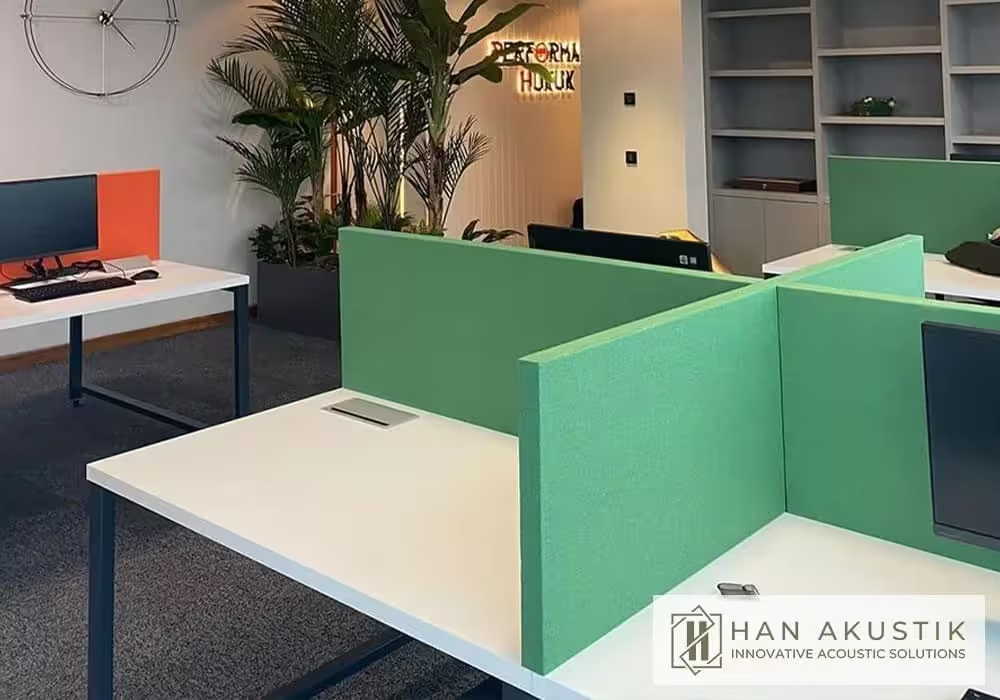
What Is Office Acoustics? A Complete Guide to Sound in the Modern Workplace
Read article →
Open-Plan Office Acoustics: How ISO 3382-3 and ISO 22955 Define Good Sound
Read article →