
Distraction Distance and Speech Privacy: The Two Metrics That Decide Open-Plan Comfort

Distraction Distance and Speech Privacy: The Two Metrics That Decide Open-Plan Comfort
Distraction distance (rD) is the distance from a talker at which nearby speech stops being intelligible enough to distract a listener — measured as the point where the Speech Transmission Index (STI) drops below 0.50. Privacy distance (rP) is the same idea one step further: the distance where STI falls below 0.20, beyond which speech is essentially unintelligible. In a poorly treated open-plan floor, rD can exceed 10 meters — meaning a phone call two rows away still steals your attention. In a well-treated one, rD shrinks to under 5 meters. Of everything we measure during a site survey, this single number correlates most closely with how many complaint emails facilities receives after move-in.
If you manage an office acoustics project, budget conversation, or renovation brief, distraction distance is the metric worth understanding in isolation — separate from the fuller ISO 3382-3 parameter set we cover in our deep dive on open-plan office acoustics under ISO 3382-3. This article stays narrowly on rD and rP: what they mean, why they predict dissatisfaction better than reverberation time or decibel readings alone, and — most usefully — the three concrete levers that shorten them.

What Do Distraction Distance and Privacy Distance Actually Mean?
Both terms come from ISO 3382-3, the international standard for measuring open-plan office acoustics, introduced in 2012. The standard defines a family of parameters around one central question: as you walk away from someone talking, at what point does their speech stop being a problem?
- Distraction distance (rD): the radius within which STI is still ≥ 0.50. Inside that radius, speech is intelligible enough that a listener’s brain automatically processes the words — even unwillingly — and that processing competes with whatever cognitive task the listener is trying to do. ISO 3382-3 treats rD > 10 m as poor and rD < 5 m as a good target for open-plan layouts.
- Privacy distance (rP): the radius within which STI is still ≥ 0.20. Beyond rP, speech has degraded enough that the listener can tell someone is talking but cannot reliably follow the content. This is the practical definition of acoustic privacy for a conversation — not silence, but unintelligibility.
The gap between rD and rP matters as much as either number alone. A large gap means there’s a wide “annoying but not quite private” zone around every desk — you can tell what your neighbor is saying, but not clearly enough to ignore, and not badly enough to forget it’s happening. Shrinking that gap, or shrinking both distances outright, is the practical goal of any open-plan acoustic design.
For the rest of the ISO 3382-3 parameter set — the spatial decay rate of speech (D2,S), the speech level at 4 meters (Lp,A,S,4m), and background noise level (Lp,A,B) — see our companion article on the full ISO 3382-3 framework. Here, we’re isolating the two numbers that most directly describe what an employee actually experiences at their desk.
Understanding STI in Plain Terms: What 0.5 and 0.2 Feel Like
The Speech Transmission Index (STI) is a 0-to-1 scale describing how faithfully speech carries from a talker to a listener through a room. It accounts for reverberation, background noise, and distance simultaneously, which is why it’s a better single predictor of real-world experience than reverberation time or decibel level alone. A quick intuitive reference:
| STI value | What it sounds like in practice |
|---|---|
| 1.0 – 0.75 | Excellent to good intelligibility — every word clear, like sitting across a quiet meeting table |
| 0.60 – 0.75 | Fair — most words understood with some effort |
| 0.50 | The distraction threshold (rD) — words are understandable enough to pull attention away from other work |
| 0.20 – 0.45 | Poor to fair — fragments and tone audible, full sentences hard to reconstruct |
| 0.20 | The privacy threshold (rP) — speech content is essentially unrecoverable, only presence of talking is noticeable |
| below 0.20 | Bad — speech is unintelligible; only rhythm/tone remain |
The reason these two thresholds — 0.50 and 0.20 — were chosen isn’t arbitrary. They map to a well-documented cognitive effect: intelligible background speech (the “irrelevant speech effect”) can cut performance on memory and cognitive tasks by up to two-thirds compared with silence or unintelligible noise. Above STI 0.50, your brain is still decoding words even when you don’t want it to. Below STI 0.20, there’s nothing left to decode, so the distraction effect collapses even if you can still faintly hear that someone is talking.
This is also why distraction distance is such a useful design target rather than an abstract lab number: it converts an intangible listening experience directly into a physical distance you can plan a floor plate around.
Why Distraction Distance Is the Single Best Predictor of Open-Plan Dissatisfaction
We survey a lot of open-plan floors, and reverberation time (RT60) alone rarely explains the complaint pattern facilities teams describe to us. Two floors with near-identical RT60 can produce very different satisfaction scores, because RT60 doesn’t account for how far speech actually carries intelligibly between desks, or how loud the ambient noise floor is relative to that speech. Distraction distance does both, in one number.
In practice, we see a fairly consistent pattern across client floors:
- rD > 10 m (poor): desks are essentially in one continuous “hearing zone.” A call at one end of a bank of desks is intelligible ten-plus meters away — near enough to cover most or all of an open floor plate. Complaint volume, requests for headphones, and demand for enclosed focus rooms all spike.
- rD 6–10 m (marginal): distraction is limited to nearby neighbors, roughly the desks in direct line of sight, but still frequent enough to be a top-three complaint in post-occupancy surveys.
- rD < 5 m (good target): distraction is largely confined to the immediate desk cluster; most of the floor operates below the intelligibility threshold for any given talker. This is the target ISO 3382-3 associates with good open-plan conditions.
Why does this happen mechanically? Distraction distance is a function of three things acting together: how loud speech is at the source and how far it projects (governed by absorption and the room’s reverberation), whether anything physically blocks the sound path (screens, furniture, partial walls), and how high the ambient background noise floor sits relative to that speech. Change any one of the three, and rD moves. Change more than one, and the effect compounds — which is exactly the logic behind the “ABC rule” outlined in our article on absorption, masking, and screens as combined tools, and part of why open-plan layouts feel distracting even when a floor looks well finished and modern.

The Three Levers That Shorten Distraction Distance
Every intervention we specify for open-plan speech privacy maps back to the same three-letter framework: Absorb, Block, Cover — the ABC rule. Each lever acts on a different physical mechanism, which is why the most effective designs combine all three rather than over-investing in just one.
A — Absorb (ceiling and wall treatment)
Absorption reduces how much sound energy reflects around the room, which lowers both the reverberant buildup of speech and the effective sound pressure level a listener receives at distance. A high-NRC ceiling (and, where geometry demands it, wall absorption) directly reduces the speech level at any given distance — meaning STI crosses the 0.50 threshold sooner, i.e., closer to the talker. Ceiling treatment is almost always the first lever we specify, because it affects the entire floor plate at once rather than desk-by-desk.
B — Block (screens and partial partitions)
Screens, desk dividers, and partial-height partitions don’t absorb much sound on their own, but they interrupt the direct, line-of-sight sound path between talker and listener — the dominant path for close-range speech transmission before reverberant reflections take over. A properly sized screen (tall enough and close enough to break sightline at seated head height) can meaningfully shorten rD for the desks immediately behind it, even without any other change. Where a fuller physical separation is justified — between a team pod and a quiet zone, for instance — a movable partition wall gives you the blocking effect of a fixed wall with the flexibility to reconfigure the floor later.
C — Cover (sound masking)
Sound masking doesn’t reduce speech at all — it raises the room’s ambient background noise floor with an engineered, speech-spectrum-shaped sound delivered through ceiling speakers, so that the signal-to-noise ratio between speech and background drops. Since STI is fundamentally a signal-to-noise measurement, raising the noise floor pushes the point at which STI crosses 0.50 closer to the talker, shrinking rD without changing anything else in the room. The effective range is narrow and worth respecting: 45–48 dBA is the optimal masking level. Below roughly 42 dBA, masking is essentially inaudible and does nothing; above roughly 50 dBA, occupants perceive it as intrusive HVAC-like noise and — counterproductively — start talking louder to compensate, which can partially undo the gain.
| Lever (ABC) | What it physically changes | Effect on distraction distance |
|---|---|---|
| A — Absorb (ceiling/wall NRC treatment) | Reduces reverberant buildup and speech level at distance | Shrinks rD across the whole floor; usually the largest single-lever gain |
| B — Block (screens, partial partitions, movable partition walls) | Interrupts direct line-of-sight sound path | Shrinks rD locally, strongest for the desks immediately behind the barrier |
| C — Cover (sound masking, 45–48 dBA) | Raises the background noise floor, lowering speech signal-to-noise ratio | Shrinks rD floor-wide; must stay in the 45–48 dBA band to avoid backfiring |
No single lever gets a poor floor to a good rD on its own in most real installations. Absorption alone tends to move rD from “poor” into the marginal range; adding blocking and masking is usually what pushes a floor from marginal into the good target zone.
A Worked, Intuitive Example: 12 Meters to 5 Meters
Picture a typical open floor as we often find it during a site survey: a hard, reflective ceiling (acoustic tile absent or degraded), open bench desking with no screens, and no masking system — just HVAC hum sitting at a low, uneven background level. In that condition, we regularly measure distraction distances in the 10–13 meter range: a conversation at one end of a desk bank is still intelligible enough to distract someone three or four workstations away.
Here’s roughly how that changes as levers are added, based on the pattern we see across comparable floors:
- Starting point: rD ≈ 12 m. Reflective ceiling, no screens, inconsistent low background noise. Nearly a third of the floor is within the distraction radius of any given talker.
- Add ceiling absorption (A): treating the ceiling with a high-NRC acoustic system reduces reverberant buildup and lowers the effective speech level at distance. rD typically drops into the 8–9 m range — a meaningful improvement, but still marginal by ISO 3382-3 standards.
- Add a 1.5 m screen at desk clusters (B): breaking direct line-of-sight between adjacent talkers and listeners further shortens the effective transmission path for the desks it shields. Combined with the ceiling treatment already in place, rD for those clusters typically moves into the 6–7 m range.
- Add sound masking at 45–48 dBA (C): raising the background noise floor to the optimal masking band pushes the STI-0.50 crossing point closer still. With all three levers combined, rD commonly lands around 5 meters — inside the ISO 3382-3 “good” target.
The exact numbers will vary with ceiling height, desk density, and existing background noise on any specific floor — this is illustrative of the pattern, not a substitute for a measured baseline. It is, however, a realistic sequence: absorption first (biggest single-lever gain), blocking second (targeted at the worst desk clusters), masking last (fine-tuning the floor-wide noise floor). We walk through this sequencing, along with the layout logic for screens and desk pods, in our article on combining absorption, masking, and screens.

A Realistic Trust Note: Privacy Distance in a Fully Open Floor Is Hard
We’d rather set the right expectation here than oversell the ABC rule. Getting distraction distance (rD) down to a good target — under 5 meters — is a realistic, achievable goal in a well-designed open floor using absorption, blocking, and masking together. Getting privacy distance (rP) down to a similarly tight radius across an entire open-plan floor is a much harder, and often unrealistic, target. STI 0.20 is a low bar for speech to clear — it takes a genuinely low signal-to-noise ratio, which in an open floor usually means either very short sightlines or a masking level pushed uncomfortably close to the upper edge of the effective range.
This is precisely why fully enclosed rooms — phone booths, focus rooms, meeting rooms with real ceiling-to-ceiling walls — remain part of almost every well-designed office, even one with excellent open-floor treatment. Open-plan levers shrink the distraction radius effectively; they do not replace a physical enclosure when true privacy is the requirement — for confidential HR conversations, client calls, or sensitive video meetings. We cover that specific problem, and the acoustic requirements for glass-walled or lightweight enclosed rooms, in our article on speech privacy for office video calls. If your floor plan is being finalized now, it’s worth deciding upfront which conversations genuinely need an enclosed room and which just need the ABC rule applied well — that decision changes both layout and budget.
For context on how these targets fit into the wider acoustic brief for an office fit-out — including the baseline concepts of reverberation and absorption this article assumes — start with our introductory guide to what office acoustics actually covers. If your floor’s issue is more about a wall separating two tenants or departments rather than open-desk distraction, that’s a different problem addressed by wall sound insulation rather than absorption or masking.
How We Approach This in a Site Survey
Distraction distance isn’t something you can estimate reliably from a floor plan alone — it depends on measured reverberation, actual desk geometry, screen heights, ceiling condition, and the existing background noise floor, all of which interact. In our surveys for office acoustics engagements, we measure STI decay directly at representative desk positions, establish the current rD and rP, and then model which combination of ceiling treatment, screening, and masking gets a specific floor to its target most cost-effectively — rather than defaulting to a blanket ceiling-only or masking-only spec. We’ve applied this same site-survey-to-installation process on layouts ranging from dense trading-floor-style desking to hybrid team-pod designs, an approach documented in more detail on our office design project page.
If you’re planning a new fit-out, a renovation, or you’re troubleshooting complaints on an existing floor, the fastest way to know where you actually stand is a measurement, not a guess. Request a site survey or acoustic measurement and we’ll give you a measured rD/rP baseline along with a prioritized, budgeted plan to close the gap.
Frequently Asked Questions
What is a good distraction distance for an open-plan office?
Under ISO 3382-3, a distraction distance (rD) below 5 meters is the target for good open-plan conditions. Above 10 meters is classified as poor, and the 5–10 meter range is generally treated as marginal — workable, but likely to generate ongoing complaints.
What’s the difference between distraction distance and privacy distance?
Distraction distance (rD) is where speech intelligibility (STI) drops below 0.50 — the point where nearby speech stops being distracting. Privacy distance (rP) is the further point where STI drops below 0.20 — where speech content becomes essentially unintelligible, which is the practical definition of acoustic privacy.
Can sound masking alone fix a poor distraction distance?
Rarely on its own. Masking (optimally 45–48 dBA) raises the background noise floor and shortens rD, but floors with reflective ceilings and no visual blocking usually need absorption and screening as well to reach a good rD target. Masking is most effective as the final fine-tuning lever after absorption and blocking are in place.
Does reverberation time (RT60) predict distraction distance?
Not reliably on its own. RT60 measures how long sound persists in a room but doesn’t directly account for background noise level or line-of-sight blocking between talker and listener — both of which strongly influence STI and therefore distraction distance. Two floors with similar RT60 can have very different distraction distances.
Is it possible to achieve full speech privacy (short rP) in a fully open floor?
It’s difficult and often impractical. Reaching a low privacy distance across an entire open floor generally requires very tight sightlines or masking levels pushed toward the uncomfortable end of the effective range. For conversations that genuinely require privacy, an enclosed room remains the reliable solution, alongside open-floor treatment for general distraction control.
How is distraction distance actually measured on-site?
It’s measured using an STI measurement system with a calibrated speech source and receiver, walking the receiver position outward from the source along representative sightlines until STI crosses 0.50 (for rD) and 0.20 (for rP), per the ISO 3382-3 test procedure — typically performed during an on-site acoustic survey rather than estimated from drawings.
Designing silence for real spaces.
Offices, hotels, restaurants, schools and healthcare — measured acoustic solutions, delivered end to end.
Related articles

Open-Plan Office Acoustics: How ISO 3382-3 and ISO 22955 Define Good Sound
Read article →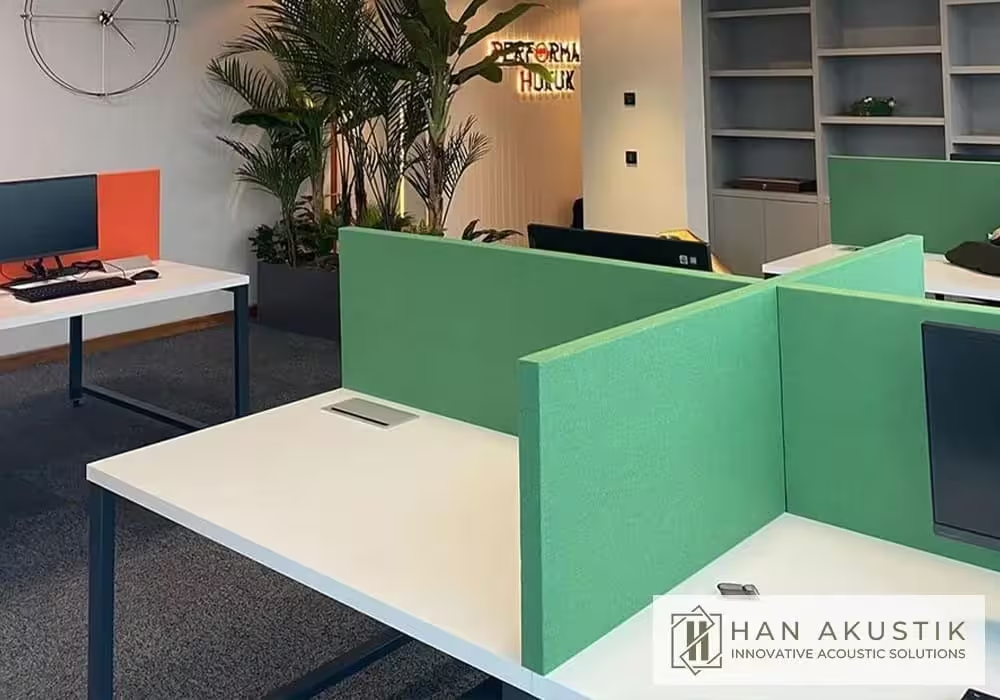
What Is Office Acoustics? A Complete Guide to Sound in the Modern Workplace
Read article →