
Open-Plan Office Acoustics: How ISO 3382-3 and ISO 22955 Define Good Sound

Open-Plan Office Acoustics: How ISO 3382-3 and ISO 22955 Define Good Sound
Good open-plan office acoustics is not “quiet” — it is measurable control over how far speech travels before it stops being intelligible. ISO 3382-3 defines this with parameters like the spatial decay rate of speech (D2,S ≥ 7 dB is a good target), distraction distance (rD < 5 m is good, > 10 m is poor), and privacy distance (rP), while ISO 22955:2021 adds design targets by activity type. Together they turn “this office feels noisy” into numbers a facility manager can act on.
Most complaints we hear during a site survey sound the same: “I can hear every word of my colleague’s call three desks away.” That sentence is, almost word for word, a description of a distraction-distance problem. The person isn’t reacting to loudness — a quiet, intelligible voice is often more distracting than a loud, muffled one. ISO 3382-3 exists precisely because “noisy office” complaints are really about intelligibility over distance, not decibels alone. This article walks through what the standard measures, how we measure it in the field, what ISO 22955 adds on top, and which physical levers actually move the numbers.
Why decibels alone don’t explain open-plan complaints
If you only look at an overall A-weighted sound pressure level (dBA), two very different open offices can read almost identically — one where colleagues’ conversations are perfectly intelligible from ten desks away, and one where the same overall level is dominated by unintelligible background hum from HVAC and distant chatter. Occupants rate the first as “distracting” and the second as “tolerable,” even though a basic sound level meter might show similar dBA numbers.
The missing variable is speech intelligibility as a function of distance. This is why ISO 3382-3 was written specifically for open-plan offices rather than relying on the reverberation-time-based methods used for cellular rooms (the kind we cover in our article on what reverberation time actually measures). An open office has no four walls to define a reverberant field — sound decays gradually along a line of desks, and it’s that decay rate, and where intelligibility crosses key thresholds, that predicts occupant experience. For general background on why the open floor plan creates this problem in the first place, see our overview of what office acoustics actually covers and our deeper look at why open-plan offices are inherently distracting.
The ISO 3382-3 parameters, explained one by one
ISO 3382-3 (introduced in 2012) gives acoustic consultants a standardized method for measuring and reporting five core parameters. We’ll take them one at a time, because each answers a slightly different practical question.
D2,S — spatial decay rate of speech
D2,S measures how many decibels the A-weighted speech level drops every time the distance from a talker doubles (from 2 m to 4 m, 4 m to 8 m, and so on), measured along a line of workstations. Think of it as the office’s natural “volume fade” as you walk away from someone talking.
- Poor: D2,S < 5 dB per doubling — speech barely fades; a conversation four desks away sounds nearly as clear as one two desks away.
- Good target: D2,S ≥ 7 dB per doubling — speech attenuates quickly enough that distance genuinely buys you privacy.
A low D2,S is the signature of a “hard” open office: high, reflective ceilings, glass partitions, hard flooring, and few sound-absorbing surfaces along the sightline between desks. Nothing is stopping or absorbing the speech energy as it propagates, so it barely decays.
Lp,A,S,4m — speech level at 4 metres
This is simply the A-weighted sound pressure level of normal conversational speech measured 4 metres from the talker, along the same line of desks used for D2,S.
- Poor: Lp,A,S,4m > 50 dB — a colleague’s normal voice is still clearly audible and loud four desks away.
- Good target: roughly ≤ 48 dB — speech has faded enough at that distance to blend into the background.
This parameter is useful because it’s intuitive to explain to a client: “at four metres, your colleague’s voice should have faded to about background-noise level, not still be clearly audible.”
rD — distraction distance
Distraction distance is the distance at which the Speech Transmission Index (STI) — a 0-to-1 scale of how intelligible speech is — drops below 0.50. Below an STI of 0.5, speech is generally understood as present but not fully followable; above it, most listeners can extract full sentences and meaning, which is what actually pulls attention away from a task.
- Poor: rD > 10 m — speech remains distracting across most of an open floor.
- Good target: rD < 5 m — only the immediately adjacent desks fall inside the distracting radius.
rD is, in our experience, the single number that correlates most closely with real complaint volume. If you want to understand why this specific metric matters so much for cognitive performance, we go into the mechanism — the “irrelevant speech effect” — in our dedicated article on distraction distance and speech privacy.
rP — privacy distance
Privacy distance is the distance at which STI drops below 0.20 — the threshold below which speech content is essentially unintelligible, even if you can still tell someone is talking. Beyond rP, conversational confidentiality is effectively achieved. rP is always larger than rD (privacy requires more distance/attenuation than merely reducing distraction), and it’s the relevant metric for anything involving confidential conversations — HR discussions, client calls, sensitive negotiations — happening at open desks rather than in an enclosed room. For teams that do most of this over video calls rather than face-to-face, this same STI logic extends to the shared-space challenges we cover in our article on speech privacy during video calls.
Lp,A,B — average background noise level
This is the underlying ambient sound level in the space — HVAC, general activity hum, equipment — when no one nearby is talking. It matters because background noise level directly affects the effective STI at any distance: a higher, well-shaped background noise raises the noise floor that speech has to compete against, which is exactly the mechanism sound masking exploits deliberately (more on that below). A background level that’s too low, ironically, makes distraction worse, because there’s nothing to bury distant conversation in.
Summary table: ISO 3382-3 parameters at a glance
| Parameter | What it measures | Poor | Good target |
|---|---|---|---|
| D2,S | Spatial decay rate of speech (dB per distance doubling) | < 5 dB | ≥ 7 dB |
| Lp,A,S,4m | A-weighted speech level at 4 m from talker | > 50 dB | ≤ ~48 dB |
| rD (distraction distance) | Distance where STI drops below 0.50 | > 10 m | < 5 m |
| rP (privacy distance) | Distance where STI drops below 0.20 | Large / not reached | Reached close to source |
| Lp,A,B | Average background noise level | Too low or unshaped | Steady, speech-spectrum-shaped |
How we actually measure this on site
ISO 3382-3 measurements are not a single sound-level-meter reading — they follow a defined field method, and knowing what it involves helps set expectations for a survey visit.
- Set up a source loudspeaker at a simulated talker position — typically at a vacant workstation, at seated head height, reproducing calibrated speech-like noise at a standardized level.
- Place microphones along a straight line of workstations radiating outward from the source, at each successive desk position (the standard specifies measurement distances so the decay curve can be fitted).
- Record the A-weighted level and STI at each microphone position, building a decay curve for D2,S and identifying where STI crosses the 0.50 and 0.20 thresholds to get rD and rP directly.
- Repeat along multiple lines/directions if the floor plan isn’t uniform (open offices are rarely perfectly symmetric — furniture, columns, and partial-height screens all change the picture depending on which way you walk).
- Log background noise separately, with the HVAC and normal occupant activity running but without deliberate speech, to get Lp,A,B.
- Repeat at a few representative source positions — a corner desk behaves differently from a desk in the middle of an open bay, and clients are usually surprised by how much the numbers vary across a single floor.
In practice, this is a half-day to full-day exercise for a mid-sized floor, and it’s the same underlying survey process — instrumentation, calibration, multi-position logging — described in general terms in our article on how an acoustic measurement is actually performed. The output is a set of curves and numbers per zone, not a single office-wide verdict — which is exactly why a spreadsheet of “average dBA” from a generic noise app can’t substitute for a proper ISO 3382-3 survey.

ISO 22955:2021 — what it adds on top of ISO 3382-3
ISO 3382-3 tells you how to measure spatial decay, distraction distance, and privacy distance. It does not tell you what target value is appropriate for a specific type of workspace — a trading floor, a software team’s collaboration zone, and a quiet accounting bay have genuinely different acoustic needs, and a single blanket target misses that.
ISO 22955:2021, “Acoustic quality of open office spaces,” fills that gap. It is a broader, design-oriented standard that:
- Classifies open-plan spaces by activity and space type — for example, individual focused work areas versus collaborative or transactional zones — recognizing that a space where people need deep concentration has different acoustic requirements than one designed for active team discussion.
- Provides design targets per classification, so a project brief can specify “this zone should meet the acoustic performance appropriate for focused individual work” rather than relying on one-size-fits-all numbers.
- Covers the design process end-to-end, addressing layout, furniture, absorption, and masking together as a system rather than treating each element in isolation.
- Complements ISO 3382-3 rather than replacing it — ISO 3382-3 remains the measurement method; ISO 22955 tells you which target from that method’s parameter set is appropriate for the space you’re actually designing or auditing.
In our design work, we typically use ISO 22955’s classification logic at the brief stage — to agree with the client what each zone of the floor is for — and then use ISO 3382-3 measurement to verify, after installation, that the space actually delivers on that classification. If you want to see how that brief-to-verification sequence plays out on a real project, our article on taking an office acoustic design from brief to handover covers the process in detail, and our office design project page shows a completed example.
What a poor score actually feels like — and which lever fixes it
Numbers on a report are only useful if they map back to what people experience at their desks. Here’s how each parameter failure typically shows up, and which control brings it back into range. We use what our team calls the ABC rule: Absorb, Block, Cover.
| Symptom occupants report | Likely metric failing | Primary lever (ABC) |
|---|---|---|
| “I can hear full conversations from across the floor” | Low D2,S, long rD | Absorb — ceiling and wall absorption to increase decay rate |
| “Confidential calls at my desk aren’t private at all” | Long rP | Block — screens/partitions to add a direct-path barrier, plus absorption |
| “It’s dead silent until someone talks, then it’s jarring” | Very low Lp,A,B | Cover — sound masking to raise and stabilize the background floor |
| “The office feels like a library, then a bomb goes off” | Inconsistent Lp,A,B across zones | Cover — even, speech-spectrum-shaped masking throughout |
| “Even with a raised floor and dropped ceiling, I still hear my neighbor” | Screens present but D2,S still low | Absorb + Block combined — screens alone rarely fix decay rate without ceiling/wall treatment |
- Absorb: High-NRC ceiling tiles or baffles, and absorptive wall panels along sightlines between desks, are usually the highest-leverage fix for D2,S, because they remove reflected energy that would otherwise carry speech further before it decays. We cover this in more depth, alongside masking, in our article on absorption, screens, and masking as complementary layers.
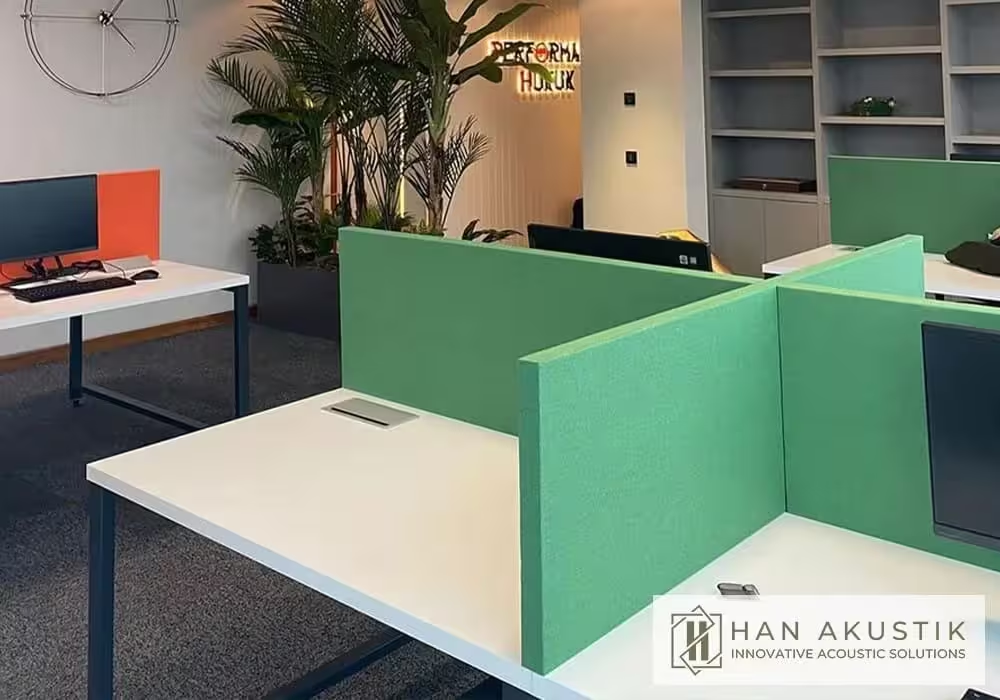
- Block: Partial-height screens and partitions physically interrupt the direct line of sound propagation between adjacent desks, which is often the fastest way to shorten rP for confidentiality-sensitive zones. For floor-to-ceiling separation between rooms rather than open desks, see our sound insulation solutions for wall, door, and partition options.
- Cover: Engineered sound masking — speech-spectrum-shaped background sound delivered through ceiling speakers — raises the effective noise floor so distant, already-attenuated speech drops below the intelligibility threshold sooner. It works best in the 45–48 dBA range: below roughly 42 dBA it doesn’t meaningfully help, and above roughly 50 dBA occupants perceive it as annoying mechanical noise and start talking louder to compensate, which defeats the purpose.
What “good” is realistically worth to occupants
It’s worth being direct about what these numbers buy you, because clients sometimes expect acoustic treatment to make an open office feel like a private room — it won’t, and a credible consultant should say so up front. Intelligible colleague speech triggers what’s known as the irrelevant speech effect, and studies associated with this line of research have found it can cut performance on memory- and language-based cognitive tasks by as much as two-thirds. Short-term memory tasks and reading/writing work are hit hardest; open-plan noise more generally is also linked to elevated stress and annoyance compared with cellular or shared-office layouts.
Given that, the realistic goal of an ISO 3382-3/22955-informed design is not silence — it’s shrinking the radius within which intelligible speech reaches someone, and giving people a background sound environment stable enough that the office doesn’t lurch between library-silent and briefly disruptive. Frameworks like WELL v2’s Sound concept and LEED v4.1’s IEQ Acoustic Performance credit both recognize this same balance at a policy level, setting background-noise and reverberation expectations for occupant wellbeing rather than mandating unrealistic silence. Getting there is a design exercise across ceiling, floor, screens, and masking together — not a single product purchase — which is why we run this as part of the same room acoustics service line covering everything from open offices to call centers and conference rooms, and why a completed reference like our ISKI project is worth reviewing for how the same principles play out at scale.

Where a standards-based approach saves money
Clients sometimes ask whether they can skip formal ISO 3382-3 measurement and just “add some ceiling panels.” The risk with that approach is that absorption alone, without addressing screens and masking together, frequently improves reverberation-related comfort while barely moving distraction distance — because rD is governed jointly by decay rate, background level, and direct-path geometry, not absorption alone. A standards-based survey tells you, before you spend money, which of the three ABC levers is actually the bottleneck in your specific floor plan, and by how much each intervention is expected to move D2,S, rD, and rP. That’s the difference between buying acoustic panels because they’re marketed as a solution, and specifying the right combination because the numbers say so — a distinction we cover more broadly in our guide to reading an acoustic report and measured solutions versus catalog panel guesses.
Request a site survey
If you’re seeing recurring complaints about overheard conversations, low-privacy desks, or an inconsistent noise floor, the fastest way to know which lever will actually fix it is an ISO 3382-3 measurement of your floor. Our team runs the same source-and-microphone survey method described above, on-site, and reports back D2,S, rD, rP, and Lp,A,B per zone with specific, prioritized recommendations. Request a site survey or acoustic measurement and we’ll walk you through what the numbers on your floor actually mean.
FAQ
What is a good distraction distance (rD) for an open-plan office?
A distraction distance under 5 metres is considered good under ISO 3382-3 — meaning intelligible speech (STI ≥ 0.50) only reaches the immediately adjacent one or two desks. A distraction distance beyond 10 metres is classified as poor and typically correlates with widespread complaints about overheard conversations across the floor.
What’s the difference between distraction distance and privacy distance?
Distraction distance (rD) is where STI drops below 0.50 — the point where speech stops being fully followable and stops interrupting a listener’s task. Privacy distance (rP) is where STI drops below 0.20 — the point where speech content is essentially unintelligible, which is the relevant threshold for confidentiality rather than mere distraction. rP is always the larger of the two distances.
Does ISO 3382-3 apply to enclosed meeting rooms too?
No. ISO 3382-3 is specifically written for open-plan offices, where sound decays gradually along a line of desks rather than building up in a reverberant field bounded by four walls. Enclosed rooms are instead assessed with reverberation time (RT60) and speech intelligibility metrics like STI, which we cover in our article on speech intelligibility in meeting rooms.
Can sound masking alone fix a poor ISO 3382-3 score?
Sound masking helps primarily by raising the effective background noise floor, which shortens the distance at which speech remains intelligible — but it works best combined with absorption and screening, not as a standalone fix. If the underlying spatial decay rate (D2,S) is poor because the space is acoustically hard and reflective, masking has less speech energy advantage to work with, and levels above roughly 50 dBA start to feel like intrusive HVAC noise rather than a helpful background.
What does ISO 22955:2021 add that ISO 3382-3 doesn’t cover?
ISO 3382-3 defines how to measure spatial decay, distraction distance, and privacy distance. ISO 22955:2021 goes further by classifying open-plan spaces according to activity and space type and assigning appropriate design targets to each classification, so a design brief can specify realistic, purpose-specific acoustic goals rather than a single generic number for the whole floor.
How long does an ISO 3382-3 measurement survey take?
For a mid-sized open-plan floor, a proper multi-position ISO 3382-3 survey — source and microphone setup, multiple measurement lines, and background noise logging across representative zones — typically takes a half day to a full day on site, followed by data analysis and reporting.
Designing silence for real spaces.
Offices, hotels, restaurants, schools and healthcare — measured acoustic solutions, delivered end to end.
Related articles

Video Calls Bleeding Across the Office? How to Solve Speech Privacy in the Hybrid Era
Read article →
Why Is Your Open-Plan Office So Distracting? Causes and Proven Fixes
Read article →