Call Center Acoustics: Taming Noise for Agent Focus and Call Quality
Call Center Acoustics: Taming Noise for Agent Focus and Call Quality
Call center acoustics is the discipline of controlling the cumulative noise created by dozens of agents talking simultaneously, so each agent can hear their own caller clearly without straining, and the caller doesn’t hear a wall of background chatter. The fix has four parts working together: heavy ceiling and wall absorption to soak up the babble, screens at desk and floor level to break sightlines between talkers, engineered sound masking at 45–48 dBA to cover what absorption misses, and layout/density decisions that limit how many voices compound in the first place. Skip any one part and the room reverts to the noise floor that drives up average handle time, depresses customer satisfaction scores, and burns out agents.
In our site surveys, call centers are consistently the loudest “office” space we measure — and the least understood acoustically. Facility teams often treat them like any other open-plan floor and apply generic office fixes. That’s a mistake. A call center’s noise problem is a different animal, and it needs a different, more aggressive solution.
Why Call Centers Are Acoustically Unlike a Normal Open Office
A conventional open-plan office has intermittent conversation — people talk in bursts, take calls at their desk occasionally, and much of the floor is quiet at any given moment. A call center inverts that completely. Every seat is occupied by someone actively talking, continuously, for most of the shift. There is no quiet baseline to return to.
This changes the acoustic problem in three specific ways:
- The noise source count is maximized. Instead of 2–3 simultaneous conversations on a 40-person floor, you may have 35–40 people talking at once — every desk is a talker, not just an occasional one.
- The babble is continuous, not intermittent. There’s no lull between calls the way there is between meetings, so the room never gets a chance to “reset” acoustically or psychologically.
- Both directions matter. In a normal office, distraction distance is mostly about the listener’s concentration being broken by a neighbor’s speech. In a call center, the agent’s own outbound speech has to compete with that same babble to remain intelligible to the person on the other end of the phone line. You’re solving a two-way intelligibility problem, not a one-way distraction problem.

The Mechanism: How Dozens of Simultaneous Talkers Create a Rising Noise Floor
To fix call center noise, it helps to understand exactly how it builds, because the mechanism is what tells you which levers actually work.
Cumulative Speech Level Adds Up Logarithmically — But It Still Adds Up
Sound levels combine logarithmically, not linearly, so doubling the number of talkers doesn’t double the decibel reading — but it does raise it measurably, and in a dense call center floor with 30+ active talkers, that cumulative rise is substantial. Every additional occupied seat within earshot pushes the ambient speech level (what ISO 3382-3 calls Lp,A,S,4m, the A-weighted speech level at 4 meters) upward. In a poorly treated open-plan space this figure alone can exceed 50 dB — already flagged as “poor” under ISO 3382-3 — before you even factor in call-center-specific density.
Distraction Distance Collapses in Hard-Surfaced, Densely Packed Rooms
Distraction distance (rD) is the distance at which the Speech Transmission Index (STI) of a neighboring conversation drops below 0.50 — in other words, the radius within which someone else’s speech is still intelligible enough to distract you. ISO 3382-3 sets >10 m as poor and <5 m as the target for good conditions. In a hard-surfaced call center with low ceilings, exposed slab, and glass partitions, we routinely measure distraction distances well beyond 10 m, meaning every agent is within the “distracting” radius of many neighbors at once — not just the person next to them.
D2,S: The Spatial Decay Rate Tells You How Fast Speech Dies With Distance
D2,S measures how many dB the speech level drops each time you double the distance from the talker. A good open-plan result is ≥7 dB per doubling; a poor one is <5 dB. Low D2,S means sound is being carried and reflected efficiently across the floor by hard ceilings and walls instead of dying off — exactly the condition that lets speech from one side of a call center bleed into another agent’s headset pickup and concentration.
The Lombard Effect: A Feedback Loop That Makes Things Worse
Once ambient noise rises past a certain point, people unconsciously raise their voice to be heard over it — a well-documented phenomenon called the Lombard effect. In a call center this becomes a vicious cycle: agent A raises their voice to be heard by their caller over the room noise, which raises the room noise for agents B through Z, who then also raise their voices, which raises the noise further still. Untreated call center floors don’t just have a noise problem — they have a noise problem that actively escalates itself over the course of a shift, which is why afternoon call quality and agent fatigue are often worse than the morning’s.
Irrelevant Speech Doesn’t Just Distract — It Actively Degrades Task Performance
The data on the “irrelevant speech effect” is stark: intelligible background speech can cut performance on cognitive and short-term memory tasks by up to two-thirds (~66%). Call center work is almost entirely short-term-memory-dependent — holding account details, order numbers, and a customer’s problem in working memory while navigating a CRM screen. A noisy floor isn’t just uncomfortable for agents; it is measurably degrading the exact cognitive function their job depends on.
The Business Cost: Table
| Acoustic problem | Business impact | Root acoustic cause |
|---|---|---|
| Agent has to ask caller to repeat themselves | Longer average handle time (AHT), lower first-call resolution | Low speech-to-noise ratio at the agent’s ear; poor D2,S |
| Caller hears other agents’ conversations in the background | Lower CSAT, perceived unprofessionalism, complaints | High cumulative reverberant noise; no absorption; no masking |
| Agents raise voices to compete with room noise | Escalating overall noise floor (Lombard effect), sore throats | No ceiling/wall absorption to remove the reflected energy |
| Constant babble degrades working memory | More data-entry errors, slower call wrap-up | Irrelevant speech effect on short-term memory |
| Sustained vocal and cognitive strain over a shift | Agent fatigue, higher absenteeism, higher turnover | Cumulative exposure with no acoustic relief across the day |
| Neighboring team’s conversations bleed into a quieter zone | Coaching/QA calls, training, or manager 1:1s get interrupted | No screens or masking to control line-of-sight and level bleed |
Call center turnover is expensive to begin with — recruiting, onboarding, and ramp-to-productivity time all cost real money — and a noisy floor is a well-documented, controllable contributor to that churn. It’s one of the few acoustic problems that shows up directly on a P&L: in call quality scores, in AHT, and in attrition.

The Four-Part Fix for Call Center Acoustics
There is no single product that solves this. We’ve never measured a call center floor that was fixed by one intervention alone — it always takes the combination, applied in this order of priority.
1. Heavy Ceiling and Wall Absorption
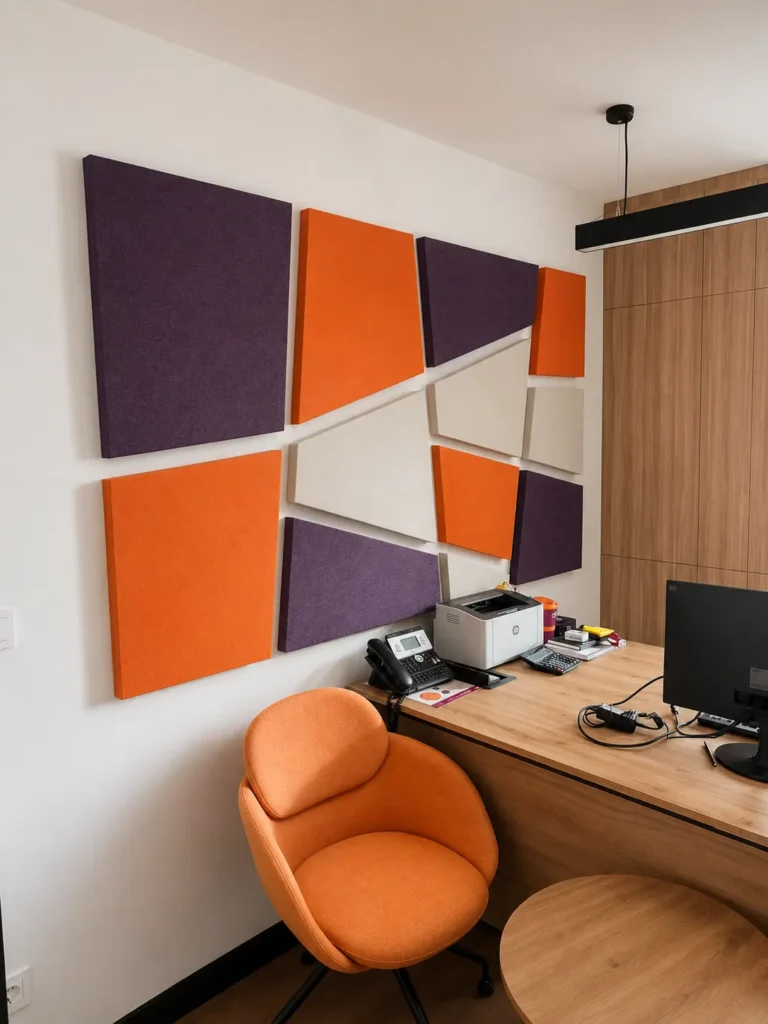
Ceiling treatment does more work than any other single measure because sound radiates upward off every talker and reflects straight back down across the whole floor if the ceiling is hard or only lightly treated. A dense, high-NRC ceiling system — rated and compared the same way we discuss for open offices generally — removes reflected energy before it can travel across desks. Perimeter and feature walls add a second layer of absorption, particularly useful where glass or hard partitions currently bounce speech back into the room. This is the “Absorb” lever, and in a call center it needs to be denser and more comprehensive than in a typical office because the source count is so much higher.
2. Desk and Floor Screens to Break Line-of-Sight
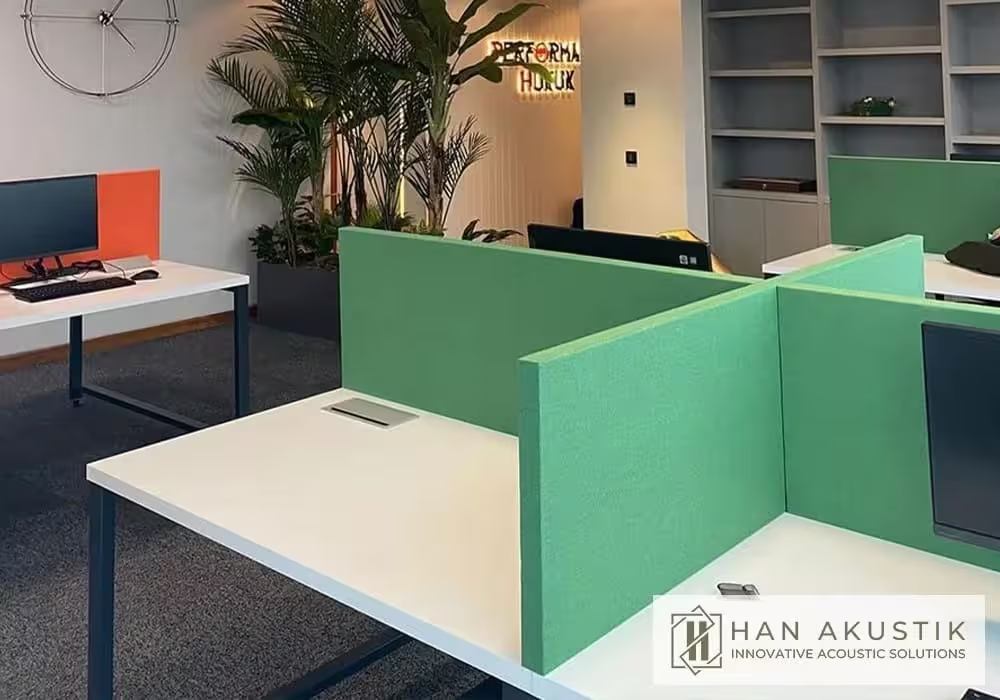
Absorption reduces the general reverberant field, but it does not stop direct, line-of-sight sound from one desk to the next. Physical screens — desk-mounted panels and, where density is high, floor-standing screens between rows — physically interrupt that direct path and shorten the effective distraction distance for the agents sitting closest together. Screens should themselves be absorptive (not just a solid divider), since a hard screen can create its own secondary reflections between two nearby desks.
3. Sound Masking at 45–48 dBA
Absorption and screens reduce the noise, but they will never eliminate it entirely — some residual babble always remains, and that residual noise is often just intelligible enough to be distracting. Engineered sound masking, delivered through ceiling speakers, raises the ambient noise floor with a steady, speech-spectrum-shaped sound so that residual speech drops below the threshold of intelligibility. The target window is narrow and matters: 45–48 dBA. Below about 42 dBA, masking is too quiet to do its job; above about 50 dBA it starts to sound like intrusive HVAC noise, and — counterproductively — it can push agents to talk louder to compete with it. This is the “Cover” lever, and it is the one most facility teams skip, usually because it’s invisible and easy to underestimate.
4. Layout and Density Decisions
The fourth lever is the one architects and facility planners control before construction even starts: how many seats per square meter, how rows are oriented relative to each other, whether team leads and QA stations sit inside the main babble or in a semi-enclosed zone, and where higher-volume teams (collections, outbound sales) sit relative to lower-volume support teams. Denser seating multiplies talker count within any given distraction radius; orienting rows so agents face away from each other (rather than across a narrow aisle) shortens direct sightlines. These decisions cost nothing to change on a drawing board and a great deal to change after fit-out, which is why we push for an acoustic review at the layout stage, not after the floor is built.
A Note on Headsets
Headset choice is a legitimate fifth factor, even though it’s not strictly a room-acoustics fix. A quality noise-canceling headset with a close-talk, noise-canceling microphone reduces how much room babble the caller hears from the agent’s side, independent of what happens to the room itself. But headsets only address the outbound leg — they do nothing for the agent’s own ability to hear their caller over the room noise, and they do nothing for agent fatigue caused by a constantly noisy environment for eight hours a day. Good headsets are a sensible complement to room treatment; they are not a substitute for it.
Agent Wellbeing and Call Quality Are the Same Problem, Not Two Problems
Facility teams sometimes frame call center acoustics as a choice between “fixing it for the customer” (call quality, CSAT) and “fixing it for the agent” (comfort, wellbeing, retention). In practice these are the same physical problem measured from two ends of the same phone line. The room-noise level that makes an agent strain to hear their caller is the identical noise that the caller hears bleeding into the call. The same background babble that pushes agents into the Lombard effect and vocal strain over a shift is the babble degrading their short-term memory for account details and scripts. There is no version of “good for CSAT but bad for agents” or vice versa in this specific problem — treating the room addresses both simultaneously, which is part of why it’s worth prioritizing over point fixes like headset upgrades alone.
Video and Remote-Agent Considerations
Many call centers now run blended or fully remote agent pools, with some agents in-office and some on video for team huddles, training, or QA reviews. The same absorption that improves live call clarity also improves how those sessions land for remote participants, for the same reason it matters in any meeting room used for video conferencing: the microphone captures room reflections and background noise just as much as it captures the speaker, so a treated room improves perceived audio quality on both ends without touching a single piece of AV equipment.
What a Site Survey for a Call Center Measures
When we survey a call center floor, we don’t rely on a single spot-check. A proper survey establishes:
- Baseline ambient noise level across representative zones of the floor (not just the quietest or loudest desk).
- D2,S and distraction distance (rD) per ISO 3382-3 methodology, at multiple sample points, to quantify how far speech is actually carrying today.
- Existing ceiling and wall absorption coefficients (or lack thereof) to model how much additional treatment is needed to hit target reverberation.
- Current sound masking presence and level, if any — many floors have an HVAC system that’s mistaken for masking but isn’t tuned to the correct spectrum or level.
- Seating density and layout, cross-referenced against the noise data to identify which zones are worst affected and why.
This baseline is what turns “the floor feels loud” into a specific, prioritized treatment plan — ceiling first, then screens, then masking tuning, then layout adjustments where feasible — rather than guesswork. It’s the same measurement discipline we apply across general office acoustics work and meeting-room speech intelligibility surveys, adapted to the much higher talker density a call center presents.
Related Reading
For teams building the business case internally, it’s worth pairing this with the underlying open-plan mechanics: what open-plan office acoustics actually measures under ISO 3382-3, why distraction distance is the metric that matters most for speech privacy, and the fundamentals of what office acoustics covers. If your facility has adjoining rooms that need to be acoustically separated from the main floor — a training room, a QA booth, or a manager’s office carved out of an open call center — a movable partition wall can create a flexible boundary without a full construction project.
Request a Call Center Acoustic Survey
If your team is asking your customers to repeat themselves, if agents are complaining about the noise, or if your CSAT and AHT numbers have quietly drifted the wrong way over the past year, the room is very likely a measurable part of the cause. A site survey gives you real numbers — ambient noise level, distraction distance, existing absorption — rather than opinions, and a treatment plan sequenced by impact and budget. Contact Han Acoustic to schedule a site survey and acoustic measurement for your call center floor.
Frequently Asked Questions
Why does my call center feel so much louder than a normal open-plan office?
Because every seat is an active talker for most of the shift, not an occasional one. A normal open office might have a handful of simultaneous conversations at any moment; a call center floor can have dozens, and the cumulative speech level, combined with the Lombard effect (people raising their voices to be heard over the babble), pushes the ambient noise floor far higher than a typical office ever reaches.
What is the ideal sound masking level for a call center?
45–48 dBA, delivered through an engineered, speech-spectrum-shaped masking system rather than relying on HVAC noise. Below roughly 42 dBA, masking doesn’t raise the noise floor enough to make residual speech unintelligible; above roughly 50 dBA, it starts to sound like intrusive mechanical noise and can push agents to talk even louder to compete with it.
Will sound masking alone fix a noisy call center?
No. Masking is one of four levers, and it’s meant to cover the residual babble that remains after ceiling and wall absorption and physical screens have already reduced the overall noise. Installing masking into an untreated, hard-surfaced room with no absorption just adds a layer of noise on top of an already-loud floor — it needs the other three elements to work as intended.
How does call center noise actually affect CSAT and average handle time?
Two mechanisms. First, when the agent can’t hear the caller clearly (low speech-to-noise ratio at their ear), calls take longer and more get escalated or repeated. Second, when the caller can hear background chatter bleeding through the call, it reads as unprofessional and lowers satisfaction scores, independent of how the actual issue was resolved.
Do noise-canceling headsets solve the acoustic problem on their own?
They help with one direction — reducing how much room noise the caller hears from the agent’s microphone — but they do nothing for the agent’s ability to hear the caller over room babble, and nothing for the cognitive fatigue of working in a loud room all day. They’re a useful complement to room treatment, not a replacement for ceiling absorption, screens, and masking.
Should acoustic treatment be planned before or after the call center floor layout is finalized?
Before, whenever possible. Seating density and row orientation directly determine how many talkers fall within each agent’s distraction radius, and those decisions are essentially free to adjust on a floor plan but expensive to change after desks, cabling, and partitions are installed. A survey at the layout stage lets absorption, screens, and masking design respond to the actual seating plan rather than being retrofitted around it.
Designing silence for real spaces.
Offices, hotels, restaurants, schools and healthcare — measured acoustic solutions, delivered end to end.
Related articles
Speech Intelligibility and STI: Making Sure Every Word Is Heard in Meeting Rooms
Read article →
Video Calls Bleeding Across the Office? How to Solve Speech Privacy in the Hybrid Era
Read article →