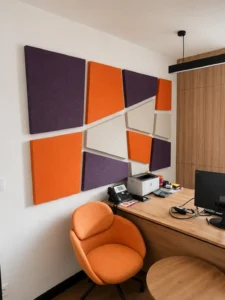
Why Do Your Conference Rooms Sound Muddy? Fixing Meeting-Room Acoustics
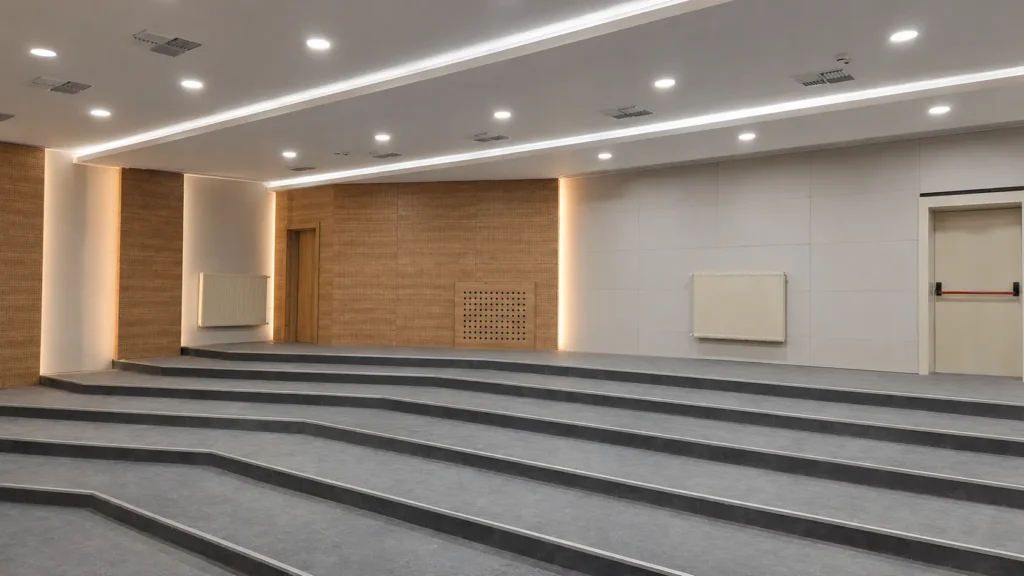
Why Do Your Conference Rooms Sound Muddy? Fixing Meeting-Room Acoustics
A conference room sounds “muddy” when its reverberation time (RT60) runs too long for speech — typically well above the 0.5–0.8 second target — so the tail of one syllable overlaps the next and blurs consonants together. The usual culprits are hard parallel surfaces (glass walls, plaster ceilings, laminate tables), little or no absorption, and HVAC noise stacked on top. The fix is almost always absorption-led — ceiling first, then the wall behind the display and any parallel wall pair — and it improves both in-room clarity and how the room sounds to people dialing in remotely.
If you’ve sat in a glass-walled meeting box and found yourself asking “sorry, can you say that again?” more than once in a 30-minute call, you’ve experienced this firsthand. It’s one of the most common complaints we hear in room acoustics site surveys, and it’s rarely a mystery once you measure the room — the physics is consistent, and so is the fix.
The Familiar Meeting-Room Complaint
The symptoms tend to repeat themselves almost word for word across completely different companies and buildings:
- People at one end of the table have to repeat themselves for people at the other end.
- Someone leans in and asks “sorry, what was that?” at least once per meeting.
- The room feels loud and tiring by the end of a long call, even though nobody was shouting.
- Remote participants on a video call say the in-room speakers “sound echoey,” “far away,” or “like you’re in a tunnel” — even when the in-room mic and speaker hardware are new and expensive.
- The room looks fine. It’s often a recently renovated, glass-fronted, minimalist box — glass, painted drywall, a hard ceiling, a laminate or glass table, and a hard floor. Nothing about it looks like it should sound bad.
That last point is what throws most facility managers: a room can look modern and well-specified and still be acoustically broken, because none of the finishes that make it look clean and premium — glass, hard ceiling tile, laminate, polished concrete or stone floors — absorb any sound. They’re all near-perfect reflectors. The room isn’t broken because of poor design intent; it’s broken because acoustic performance was never part of the design brief in the first place.
What “Muddy” Actually Means, Acoustically
“Muddy” is a plain-English description of a specific, measurable acoustic condition: excessive reverberation time relative to what a speech-dominated room needs.
RT60: the reverberation tail that smears words
As covered in detail in what is reverberation time (RT60), RT60 is the time it takes for sound to decay by 60 dB after the source stops. For meeting and conference rooms, the target is RT60 ≈ 0.5–0.8 seconds — short enough that consonants (the short, quiet, high-frequency sounds like t, k, s, f that carry most of what distinguishes one word from another) stay distinct, but not so dead that the room feels unnaturally flat.
When RT60 runs well above that range — which is common in glass-and-drywall boxes with no ceiling treatment — the reverberant tail of one syllable is still audible when the next syllable starts. The ear (and, worse, a microphone) receives the direct sound and the smeared reflected tail on top of each other, and the brain has to do extra work to separate speech from its own echo. That extra processing effort is exactly what produces the sensation of “muddiness” and the fatigue that comes with sitting through back-to-back calls in a bad room.
STI: the number that predicts whether people can actually understand each other
Speech Transmission Index (STI) is the more direct metric for “can people understand what’s being said,” scored 0–1: below 0.30 is bad, 0.30–0.45 poor, 0.45–0.60 fair, 0.60–0.75 good, and above 0.75 excellent (IEC 60268-16). Inside a meeting room, you want STI as high as possible — the opposite goal from an open-plan office, where you actually want intelligibility to drop off with distance for privacy. It’s the same metric measuring the same physical phenomenon, but a good outcome points in opposite directions depending on room type — we unpack that comparison fully in speech intelligibility (STI) in meeting rooms.
RT60 and STI are closely linked: a long reverberation tail is one of the biggest single drivers of a low STI score, alongside excess background noise and poor mic/speaker placement. When a conference room “just sounds bad,” what you’re really hearing, in almost every case we survey, is elevated RT60 dragging STI down below the “good” threshold.

Root Causes: Why Your Room Ended Up Like This
In our site surveys, the same handful of conditions show up over and over, usually stacked two or three at a time in the same room.
1. Excessive RT60 from a total absence of absorption. The room has a hard ceiling (painted plaster, hard tile, exposed structure), a hard table, a hard floor, and glass or painted-drywall walls. Nothing in the room is doing any absorptive work, so sound energy just keeps bouncing until it eventually loses enough energy to become inaudible — which, in a mid-size room with these finishes, can easily take well over a second.
2. Parallel hard surfaces causing flutter echo. Two hard, parallel, reflective surfaces facing each other — most often a pair of side walls, or a glass wall directly opposite a whiteboard or another glass wall — trap sound in a rapid back-and-forth bounce. This produces “flutter echo,” a distinct buzzy or metallic ringing quality on top of the general reverberance, and it’s especially noticeable on claps, hard consonants, and the attack of speech.
3. All-glass meeting boxes. Glass is one of the most acoustically reflective common building materials — it absorbs almost nothing across the speech frequency range. Fully glazed meeting rooms look great and support open, transparent office design, but acoustically they are close to worst-case unless deliberately treated, which is why they’re a recurring theme in nearly every conference-room complaint we get called out for.
4. No ceiling or wall absorption at all. Many conference rooms are fitted out with the same suspended ceiling tile used throughout the rest of the floor, which is chosen for cost and appearance rather than absorption performance, or with a hard, decorative ceiling that has none. Compare that against a properly specified absorptive treatment, and the difference in NRC — and therefore in RT60 — is dramatic; we cover how ceiling and wall treatment options compare directly in ceiling vs. wall acoustic treatment.
5. Poor microphone placement in a reverberant room. Even a good conferencing microphone will pick up far more reflected sound, relative to direct speech, in an untreated reverberant room than the same mic would in a room with proper absorption. No amount of mic upgrading fixes a fundamentally reverberant room — the microphone is faithfully capturing what’s actually happening acoustically, reflections and all.
6. HVAC and background noise. Air handling units, diffusers placed directly above the table, or a noisy fan-coil unit add a constant background hiss or rumble that both raises the perceived “noise” of the room and is picked up by conferencing microphones as an unwanted signal. Even a well-controlled RT60 can still feel like a “noisy” room if the underlying background level is too high — this interacts with, but is a separate issue from, reverberation itself.
Why This Also Wrecks Your Video Calls (Maybe Even Worse)
Here’s the detail most people miss: a reverberant conference room is often more punishing on a video call than it is for people physically sitting in it.
In the room, the human ear and brain do a remarkable amount of unconscious filtering — a phenomenon called the precedence effect helps us localize and prioritize the first-arriving (direct) sound over the reflections that follow, so a moderately reverberant room can still feel “okay” to the people actually in it. A microphone does none of that filtering. It captures direct speech and all the room’s reflections as one combined signal and sends that combined signal, unfiltered, straight to the remote participant’s speaker or headset. That’s exactly why the classic remote-participant complaint is “you sound echoey and far away” even when everyone in the room feels the meeting is going fine — the room’s reflections are far more audible over the call than they are in person.
Background noise compounds this the same way: HVAC hiss, hallway noise leaking through a poorly sealed door, or simple room hum all get picked up and transmitted at a level the remote side notices far more than the local participants do. As detailed in office speech privacy and video calls, the acoustic quality of the room is now effectively part of your video-conferencing equipment stack, whether or not it was ever specified that way. Treating the room’s absorption and background noise improves perceived call quality about as much as upgrading the microphone or camera — often more, and at a fraction of the cost of new AV hardware that will still be recording the same untreated room.

Symptom → Likely Cause → Fix
| Symptom | Likely Cause | Fix |
|---|---|---|
| People at the far end of the table ask others to repeat themselves | Excessive RT60 blurring consonants; low STI | Ceiling absorption sized to bring RT60 into the 0.5–0.8 s range |
| A buzzy or “boingy” ringing on claps or hard consonants | Flutter echo between parallel hard walls (often glass-to-glass or glass-to-whiteboard) | Absorptive panels on at least one of the two parallel surfaces; break up the parallel geometry where possible |
| Remote participants say you sound “echoey” or “far away” | Microphone capturing room reflections + direct speech together; the ear filters this in-room, the mic does not | Absorption near the mic/table zone and the wall behind the display; re-test the call after treatment |
| Room feels loud/tiring even without shouting | Reverberant field builds on top of direct sound (each voice adds to an already-ringing room) | Ceiling plus wall absorption to reduce the overall reflected energy in the room |
| Constant background hiss or rumble on calls, even in a quiet room | HVAC diffuser noise, especially units placed directly over the table | Reposition or baffle the diffuser; check duct velocity and grille selection; verify with a background-noise measurement |
| The room “sounds echoey” and it’s fully glazed | All-glass or mostly-glass enclosure with no ceiling treatment | Ceiling absorption first (glass usually can’t be treated directly), plus a soft floor covering if the floor is hard |
| Meeting feels fine in person but call transcripts/recordings are garbled | STI is low even though in-room perception is masked by the precedence effect | Full RT60/STI measurement of the room, not just a subjective in-room impression |
A Practical Fix Plan (In Priority Order)
We treat conference rooms in roughly this order on real projects, because it matches where the biggest RT60 reduction per euro spent is available first:
- Measure the room first. Before specifying anything, get an actual RT60 and STI reading, ideally with an occupied-equivalent estimate (a room measured empty always reads longer than the same room full of people and chairs). This tells you exactly how far above the 0.5–0.8 s target the room currently sits, and therefore how much absorption is actually missing.
- Treat the ceiling first. In almost every conference room, the ceiling is the largest unobstructed surface and the one place absorption won’t collide with a display, whiteboard, credenza, or seating. Absorptive ceiling tiles, baffles, or a suspended acoustic cloud typically close most of the RT60 gap on their own — see ceiling vs. wall acoustic treatment for how we decide how much ceiling coverage is enough before moving to walls.
- Treat the wall behind the display and any parallel wall pair. The wall directly behind the main screen is typically the wall people are facing and speaking toward, so absorption there has an outsized effect on perceived clarity and on what the conferencing microphone picks up. Any pair of hard, parallel walls — the classic flutter-echo condition — should get absorption on at least one side.
- Add a soft floor covering where the floor is hard. Carpet tile or an area rug adds meaningful mid/high-frequency absorption at the one surface ceiling and wall treatment don’t touch, and it also reduces footstep and chair-scrape noise picked up by table-mounted microphones.
- Address HVAC and background noise separately. Reposition or baffle diffusers away from directly above the table, check for excessive duct or grille noise, and re-measure background level — this is a distinct fix from absorption and won’t be solved by acoustic panels alone.
- Re-measure after installation. Confirm the finished room actually lands in the 0.5–0.8 s RT60 range and check STI has moved into the “good” (0.60–0.75) or “excellent” (>0.75) band, rather than assuming panels alone guarantee the target was hit.
For rooms with unusual geometry — cathedral ceilings, curved glass, very large boardrooms — the same priority order applies, but the sizing calculation gets more involved; that’s exactly the kind of room where a measured design, rather than a catalog panel count, earns its cost. Our Gaziantep conference hall project is a useful illustrative reference for how this scales up in a larger-volume conference space: the same RT60 and flutter-echo logic applies, just distributed across a bigger ceiling and wall area with a correspondingly larger treatment plan.

Setting Realistic Expectations
A few things worth being direct about before you commission treatment:
- Absorption reduces reverberation; it does not stop sound leaking to the room next door. If your complaint is really that the meeting next door can be heard through the wall, that’s a sound-insulation problem (mass, sealing, partition performance), not an absorption problem — the two are frequently confused, and we cover the distinction fully in sound absorption vs. soundproofing. Treating your room’s ceiling with absorptive panels will make the room sound clearer internally and improve how it sounds on calls; it will do very little for what a colleague in the corridor can overhear, which is instead the territory of ceiling sound insulation and related wall/door treatments.
- A fully glazed room can be improved but rarely made acoustically ideal without some compromise to the glass aesthetic. Ceiling and floor treatment plus careful furniture and layout choices can bring RT60 into range even with glass walls left untouched, but if the room needs to be genuinely excellent (executive boardrooms, high-stakes negotiation rooms), some acoustic treatment on at least one wall is usually part of the honest recommendation.
- Don’t over-treat. A conference room stuffed with excessive absorption can end up sounding unnaturally dead and flat — fine for intelligibility, but oddly uncomfortable to sit in for a long meeting. The 0.5–0.8 second target is a range, not a “lower is always better” instruction.
- Occupied vs. empty matters. A room measured empty will read a longer RT60 than the same room full of people, chairs, and laptops bags — all of which add real absorption. Design and measurement should account for the room’s typical occupied state, not just its empty-shell condition.
- This is a system-level problem, not just a panel-buying decision. Room geometry, glazing, ceiling type, HVAC layout, furniture, and microphone placement all interact. That’s exactly why we start every project with a measured site survey rather than a generic panel recommendation — the same visual “amount of foam” can produce completely different real-world RT60 depending on what it’s applied to and where.
This same absorption-first logic extends to other high-density speech environments under sustained pressure — a call center, for instance, deals with dozens of simultaneous conversations rather than one, but the underlying levers (ceiling and wall absorption, breaking sightlines, and managing background level) are the same family of fix; see call center acoustics: noise and focus if that’s a related space in your building. And if the wider issue is speech privacy and video-call clarity across your whole office floor rather than one conference room specifically, office speech privacy and video calls and our office acoustics service page cover that broader scope.
Request a Site Survey for Your Conference Room
If your meeting rooms sound muddy, feel tiring after a long call, or keep drawing the same “you sound far away” comment from remote participants, the fastest way to know exactly why — and how much treatment it will actually take — is a measured RT60 and STI reading rather than a guess based on how the room feels. Our team runs a full on-site acoustic survey, measures your conference room against the 0.5–0.8 second target, and designs a treatment plan sized to the actual gap: ceiling first, wall behind the display second, floor and HVAC as needed — not a generic panel package. Request a site survey or acoustic measurement and see our conference room acoustics service page for how we scope and deliver these projects end to end.
FAQ
Why does my conference room sound muddy even though it looks modern and well-finished?
Because modern, minimalist finishes — glass, painted drywall, hard ceiling tile, laminate tables, polished floors — are all acoustically reflective; none of them absorb sound. A room can look expensive and well-designed and still have an RT60 well above the 0.5–0.8 second target for speech, because acoustic performance was never part of the finish selection. The fix is adding absorption (ceiling first, then walls), not changing how the room looks overall.
What is the ideal reverberation time for a conference or boardroom?
Roughly 0.5 to 0.8 seconds, per the reference ranges we design to for speech-dominated rooms. This is short enough that consonants stay distinct and speech doesn’t blur together, but not so short that the room feels unnaturally dead. See what is reverberation time (RT60) for the full range across other room types.
Why do remote participants complain about echo more than people in the room?
Because the human ear and brain unconsciously prioritize the first-arriving direct sound over reflections (the precedence effect), so people physically in the room partially filter out the room’s own reverberation without realizing it. A conferencing microphone does no such filtering — it captures direct speech and reflected sound together and transmits that combined, unfiltered signal to the remote side, which is exactly why “you sound echoey and far away” is such a common video-call complaint even when in-room participants think the meeting sounded fine.
Will new microphones or a better speakerphone fix a muddy conference room?
Not on their own. A better microphone is still faithfully capturing whatever is acoustically happening in the room — if the room is highly reverberant, an upgraded mic will pick up more detail of that same reverberant, muddy signal, not less. Hardware upgrades help most once the room’s RT60 is already in range; treating the room first is typically the higher-impact, lower-cost fix.
Does treating my conference room’s ceiling also stop sound from leaking to the room next door?
No. Ceiling and wall absorption reduce reverberation inside the room — how long sound rings after someone stops speaking — but they do very little to stop sound transmitting through a wall, floor, or ceiling to an adjacent space. That’s a separate discipline, sound insulation, governed by mass and sealing rather than absorption; see sound absorption vs. soundproofing and ceiling sound insulation if noise transfer between rooms is your actual complaint.
Where should I start if I can only treat one surface in a conference room?
The ceiling, in the great majority of conference rooms we survey. It’s usually the largest unobstructed surface, it doesn’t compete with a display, whiteboard, or furniture, and it typically closes most of the RT60 gap on its own. From there, the wall directly behind the main display and any pair of parallel hard walls (a common source of flutter echo) are the next priority — see ceiling vs. wall acoustic treatment for the full decision process.
Designing silence for real spaces.
Offices, hotels, restaurants, schools and healthcare — measured acoustic solutions, delivered end to end.
Related articles
Speech Intelligibility and STI: Making Sure Every Word Is Heard in Meeting Rooms
Read article →
Video Calls Bleeding Across the Office? How to Solve Speech Privacy in the Hybrid Era
Read article →