
Classroom Acoustics Standards Explained: ANSI/ASA S12.60 and BB93

Classroom Acoustics Standards Explained: ANSI/ASA S12.60 and BB93
The two reference standards for classroom acoustics are ANSI/ASA S12.60 in the United States and Building Bulletin 93 (BB93) in England. ANSI/ASA S12.60 requires background noise of 35 dBA or less and a reverberation time of 0.6 seconds or less in core learning spaces up to 283 m³ (0.7 s up to 566 m³), with ancillary spaces capped at 40 dBA. BB93 is the UK’s statutory counterpart, setting indoor ambient noise limits, a comparable reverberation target of around 0.6 s for new-build teaching spaces, plus sound insulation and speech intelligibility criteria. Both standards exist for the same reason: children do not hear speech the way adults do, and a room that “sounds fine” to a facilities manager can still be acoustically failing the students sitting in the back row.
This article walks through what each standard actually requires, why the numbers are set where they are, and how to check whether an existing or planned classroom meets them.
Why classroom acoustics need a formal standard at all
Most building codes regulate structural safety, fire egress, and energy performance. Acoustics is easy to leave out — a classroom can be structurally sound, well-lit, and fully compliant with every other code, and still be a poor place to learn in. That gap is exactly what ANSI/ASA S12.60 and BB93 were written to close.
The underlying science is straightforward. Speech intelligibility depends on the signal-to-noise ratio (SNR): how much louder the teacher’s voice is than the background noise and room reflections competing with it. Adults with mature language skills, full vocabularies, and the ability to fill in missed words from context can understand speech at a fairly low SNR. Children cannot. A first-grader is still building vocabulary, has not yet developed the same top-down predictive listening skills, and — critically — has smaller ear canals and different auditory processing thresholds than an adult. The result is that children typically need an SNR several decibels higher than an adult to achieve the same comprehension score, and the deficit is larger for younger children, for students with even mild or unaddressed hearing loss, and for children learning in a second language.
This is not a marginal effect. Research consistently ties poor classroom acoustics — high background noise, long reverberation, weak sound insulation between rooms — to measurable declines in comprehension, reading and spelling scores, and standardized test outcomes, particularly for students in the back half of the room, non-native speakers, and children with undiagnosed hearing or attention difficulties. Teachers pay a physical price too: raising your voice for six hours a day, every day, in a reverberant room is a leading cause of vocal strain and chronic voice disorders among teaching staff. If your school is also weighing broader student wellbeing or noise complaints, our companion article on why students can’t hear the teacher in noisy classrooms walks through the symptom side of this same problem.
ANSI/ASA S12.60 and BB93 translate that research into enforceable numbers so that a classroom’s acoustic performance can be specified, measured, and verified — the same way you would specify a lighting level or an HVAC ventilation rate.
The three levers every classroom acoustics standard controls
Whether you’re reading ANSI/ASA S12.60, BB93, or any other national school-acoustics code, the requirements almost always break down into the same three physical levers:
- Background noise. This is the steady-state sound level in an unoccupied room from HVAC systems, mechanical equipment, and noise leaking in from outside (traffic, playgrounds, rooftop units). It is measured in dBA and sets the “noise floor” the teacher’s voice has to rise above.
- Reverberation. This is how long sound persists after the source stops, driven by how much hard, reflective surface area a room has versus how much sound-absorbing material. Long reverberation blurs consonants together (smearing “b” and “d” endings, for instance), which is exactly the acoustic information a listening child relies on most. Our detailed explainer on what reverberation time (RT60) actually measures covers the physics and the Sabine formula behind this number.
- Sound insulation between spaces. This governs how much noise from an adjacent classroom, corridor, gym, or cafeteria leaks into the teaching space. A classroom can have perfect background noise and reverberation and still be unusable if the room next door transmits every word through a shared wall.
A standard that only regulated one of these three would leave an obvious loophole — you could build a beautifully absorptive room with a paper-thin partition wall, or a well-insulated room with a hard, echoey interior. ANSI/ASA S12.60 and BB93 both regulate at least the first two directly, with insulation addressed either within the same document (ANSI) or in step with parallel guidance (BB93).

ANSI/ASA S12.60: the US classroom acoustics standard
ANSI/ASA S12.60, developed by the Acoustical Society of America, is the reference standard for classroom acoustics in the United States. It sets quantitative, measurable limits for core learning spaces:
- Background noise: ≤ 35 dBA in core learning spaces.
- Reverberation time: ≤ 0.6 seconds for classrooms up to 283 m³ in volume; ≤ 0.7 seconds for larger core learning spaces between 283 and 566 m³.
- Ancillary spaces (gymnasiums, cafeterias, corridors, and similar non-instructional areas): ≤ 40 dBA background noise, with no reverberation time limit specified — these are not spaces where continuous speech comprehension is the primary function.
- Sound insulation between classrooms: the standard also addresses the acceptable STC (Sound Transmission Class) rating between adjacent instructional spaces, so that speech and activity noise in one classroom does not compromise learning conditions in the next.
Two things are worth underlining. First, the 35 dBA background limit is stricter than it sounds — it typically requires an HVAC system with low-noise diffusers and duct silencing, not just “quiet” equipment, because mechanical noise is usually the dominant source in an occupied core learning space. Second, the 0.6 s / 0.7 s reverberation split by room volume matters in practice: a larger multi-purpose classroom or lecture-style teaching space is allowed a slightly longer decay time, but not proportionally longer — the standard recognizes that bigger rooms are inherently harder to control acoustically, while still holding the line close to the 0.6 s speech-clarity target used across most classroom-sized spaces. For context on how these figures compare with other room types, see our broader guide to ideal reverberation time by room use, which places the classroom figures alongside offices, restaurants, and auditoria.
If you are designing or retrofitting a larger teaching space — a lecture theater, tiered classroom, or assembly hall — the acoustic goals shift again, because speech now has to travel further and reach a much larger audience. Our dedicated article on lecture hall and auditorium acoustics and our theater acoustics service page both cover the design approach for these larger, higher-volume teaching and presentation spaces, where the ANSI 283–566 m³ tier and beyond typically applies.
BB93: the UK’s classroom acoustics standard
Building Bulletin 93 (“Acoustic design of schools”) is the statutory acoustic performance standard for school premises in England. It plays the same functional role that ANSI/ASA S12.60 plays in the US, but sits within UK building regulations rather than a voluntary ANSI standard, meaning compliance is a legal requirement for new-build and significantly refurbished school premises in England.
BB93 covers four areas, in line with the same three-lever logic described above:
- Indoor ambient noise levels, setting limits on background noise from building services and external sources for different categories of teaching space.
- Reverberation time, with new-build teaching spaces generally targeted at around 0.6 seconds or less — closely aligned with the ANSI/ASA S12.60 figure, reflecting the same underlying speech-intelligibility research.
- Sound insulation, setting minimum performance requirements between teaching spaces and between teaching spaces and circulation or other noisy areas.
- Speech intelligibility criteria, recognizing that noise and reverberation limits alone don’t fully guarantee a room where a teacher’s voice is clearly understood at every seat.
We’re deliberately not quoting BB93’s detailed room-by-room table values beyond the ~0.6 s teaching-space reverberation target, since the full document sets different limits by room type, size, and use (music rooms, drama studios, and open-plan teaching spaces are all treated differently from a standard enclosed classroom). If your school falls under BB93, the specific table for your room type and size is the one to design and test against — treat the figures in this article as the general shape of the requirement, not a substitute for the source document.
ANSI/ASA S12.60 vs BB93 at a glance
| ANSI/ASA S12.60 (USA) | BB93 (England) | |
|---|---|---|
| Status | Voluntary national standard, widely adopted/referenced in state codes and school design guides | Statutory requirement under English building regulations for schools |
| Background noise | ≤ 35 dBA core learning spaces; ≤ 40 dBA ancillary spaces | Indoor ambient noise limits set by room type (design guidance, not a single blanket figure) |
| Reverberation time | ≤ 0.6 s (≤ 283 m³); ≤ 0.7 s (283–566 m³) | ~≤ 0.6 s target for new-build teaching spaces, varying by room type |
| Sound insulation | Addresses acceptable STC between classrooms | Sets minimum insulation performance between teaching spaces and other areas |
| Speech intelligibility | Addressed indirectly via noise/RT limits | Explicit intelligibility criteria included |
| Scope | Core learning spaces + ancillary spaces distinguished | Teaching spaces, ancillary areas, and circulation treated distinctly by room type |
The two standards are more alike than different: both regulate the same three levers, both converge on roughly the same reverberation target for a standard-sized teaching space, and both exist to guarantee the same outcome — that a child sitting anywhere in the room can understand the teacher without strain. The practical difference is legal status (BB93 is a statutory requirement in England; ANSI/ASA S12.60 is a voluntary standard frequently referenced by US state codes and school design specifications) and the level of granularity in how each document breaks room types apart.
How to assess a classroom against the standard
Whether you’re benchmarking against ANSI/ASA S12.60, BB93, or a similar national standard, the assessment methodology is the same three-step process we run in our own site surveys:
- Measure unoccupied background noise (dBA). This is taken with HVAC running under normal operating conditions, room empty, using a calibrated sound level meter, ideally logged over a representative period to capture cycling equipment (chillers, rooftop units) rather than a single snapshot. Compare the result against the 35 dBA (or applicable ancillary) threshold.
- Measure reverberation time (RT60). Using an impulse or interrupted-noise method per the relevant test standard, RT60 is measured across octave bands in the unoccupied, furnished room and compared against the 0.6 s / 0.7 s volume-based thresholds. Our article on how acoustic measurement is actually performed explains the equipment and method behind this step in more detail, and our guide to reading an acoustic report explains how to interpret the resulting numbers once you have them.
- Measure or verify sound insulation (STC / Rw) between adjacent spaces. This checks whether the wall, door, and any flanking paths between classrooms — or between a classroom and a noisy ancillary space — meet the insulation criteria in the applicable standard. Both a lab-rated assembly and its real-world, as-built performance matter here, since flanking transmission through ceilings, ducts, or a hollow-core door can undermine an otherwise well-specified wall.
If any of the three measurements fails, the fix maps directly back to the lever that’s out of range: excess background noise usually points to HVAC/mechanical noise control or better building envelope isolation from external noise; excess reverberation points to insufficient sound absorption (typically addressed with ceiling absorption treatment or wall panels, since ceilings are usually the largest available surface in a classroom); and poor insulation between rooms points to the partition wall, door, or flanking paths rather than anything inside the room itself. It’s worth being precise about which lever is failing before specifying a fix — adding absorption panels to a room with an insulation problem will do nothing for noise coming through the wall from next door, and vice versa. For the regulatory side of insulation performance more broadly, our article on sound insulation building regulations covers how classroom insulation requirements sit within wider building-code obligations.
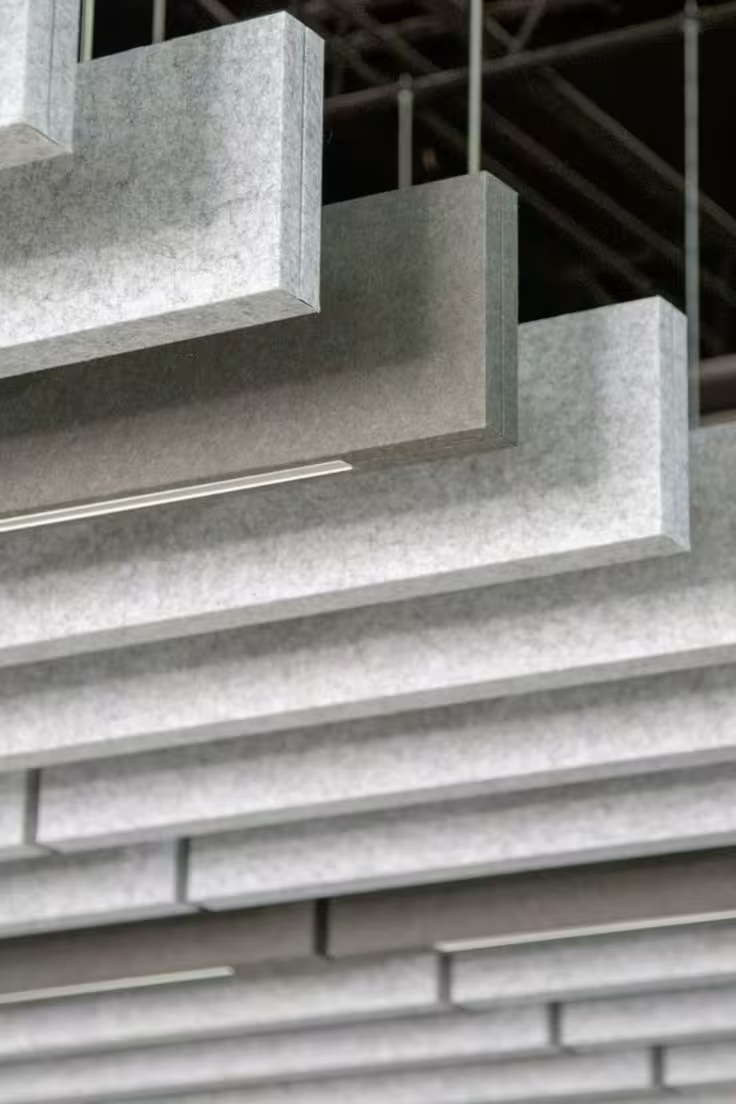
What a compliant classroom actually looks like in practice
In our own school projects, meeting ANSI/ASA S12.60 or BB93 targets rarely comes down to one dramatic intervention. It is usually a combination of: an HVAC system specified and installed with low-noise diffusers and adequately sized ductwork (addressing background noise), a ceiling and/or upper-wall absorption package sized to the room’s volume and existing hard-surface area (addressing reverberation), and a partition wall/door assembly specified — and field-verified, not just lab-rated — to the required STC or Rw (addressing insulation). Skipping the verification step is one of the most common mistakes we see: a wall assembly can carry an excellent lab STC rating on paper while performing several points worse once installed, because of an unsealed door, a shared ceiling plenum, or back-to-back electrical boxes.
It’s also worth setting realistic expectations. Absorption treatment reduces reverberation and makes speech clearer within the room; it does very little to stop sound passing into the room next door. Conversely, a well-insulated partition wall keeps noise out but does nothing about an echoey, hard-surfaced interior. Meeting a classroom acoustics standard genuinely requires addressing all three levers, not the one that happens to be cheapest to fix. For more on this general absorption-versus-insulation distinction, see ceiling vs wall acoustic treatment, and for how absorption performance is actually rated, our guide on NRC vs sound absorption coefficient is a useful companion once you’re comparing treatment options.

Speech intelligibility inside the classroom is also worth measuring directly rather than inferring from RT60 and background noise alone, particularly in larger or irregularly shaped rooms. Our article on speech intelligibility (STI) in meeting rooms explains the STI metric in a different room-type context, but the same 0–1 intelligibility scale and measurement logic applies to classrooms and lecture spaces.
Request a classroom acoustics assessment
If you manage a school building — whether you’re specifying a new build, responding to teacher or parent complaints about noise, or simply want to confirm an existing classroom meets ANSI/ASA S12.60 or BB93 — the only reliable way to know where you stand is a proper site measurement, not a walk-through impression. Our team runs the full site survey → acoustic design → production → installation process for classrooms, lecture halls, and school ancillary spaces, and can benchmark your rooms directly against the relevant standard’s numbers. Request a site survey or acoustic measurement to get a clear, measured picture of your classroom’s background noise, reverberation, and insulation performance, and a design response scoped to what’s actually failing.
Frequently asked questions
What is the classroom acoustics standard in the US?
The reference standard is ANSI/ASA S12.60, which sets a maximum background noise level of 35 dBA and a maximum reverberation time of 0.6 seconds for core learning spaces up to 283 m³ (0.7 s for spaces between 283 and 566 m³), plus a 40 dBA limit for ancillary spaces like gyms and cafeterias.
Is BB93 legally required?
Yes, in England BB93 is a statutory requirement for new-build and significantly refurbished school premises, unlike ANSI/ASA S12.60 in the US, which is a voluntary standard frequently referenced by state building codes and school design specifications rather than a federal legal mandate.
What reverberation time should a classroom have?
Both ANSI/ASA S12.60 and BB93 converge on approximately 0.6 seconds or less for a standard-sized teaching space, rising to around 0.7 seconds under ANSI for larger core learning spaces between 283 and 566 m³. This sits at the shorter end of the general 0.4–0.7 s speech-space range used across offices, meeting rooms, and classrooms.
Why do children need stricter acoustic standards than adults?
Children have smaller, still-developing auditory systems and less mature language and vocabulary skills to fall back on when speech is partially masked by noise or reverberation, so they need a higher signal-to-noise ratio than adults to achieve the same level of comprehension. The effect is larger for younger children, non-native language learners, and students with even mild, undiagnosed hearing difficulties.
Does meeting the background noise limit also fix reverberation problems?
No. Background noise and reverberation are controlled by different levers — background noise is largely an HVAC/mechanical and envelope-isolation issue, while reverberation is controlled by how much sound-absorbing surface area is in the room. A classroom can pass one criterion and fail the other; both need to be measured and addressed independently.
How do I know if my school’s classrooms meet ANSI/ASA S12.60 or BB93?
The only reliable way is a measured site assessment: unoccupied background noise in dBA, reverberation time (RT60) across octave bands, and sound insulation (STC/Rw) between adjacent spaces, each compared against the applicable standard’s thresholds. A visual walk-through or subjective impression of a room cannot substitute for calibrated measurement.
Designing silence for real spaces.
Offices, hotels, restaurants, schools and healthcare — measured acoustic solutions, delivered end to end.
