
When Students Can’t Hear the Teacher: Solving Classroom Noise

When Students Can’t Hear the Teacher: Solving Classroom Noise
Classroom noise makes speech hard to hear because a long reverberation time smears consonants together and a noisy background reduces the signal-to-noise ratio the ear needs to separate the teacher’s voice from everything else. The fix is rarely “more volume” — it is controlling both sides of that ratio: shortening reverberation time to ≤ 0.6 s with ceiling and wall absorption, and pushing background noise down toward 35 dBA, in that priority order. Get the ratio right and the same teacher, the same room, and the same students suddenly understand each other.
If you manage a school facility, you have probably already had this conversation with a teacher: they are shouting by 10am, the kids at the back of the room have stopped trying to follow along, and every lesson takes longer because instructions get repeated three times. That is not a discipline problem or a teaching-technique problem. In the large majority of the rooms we survey, it is an acoustic problem with a physical, measurable cause — and it is fixable without rebuilding the classroom. This article walks through why it happens, what it actually costs a school in learning outcomes and staff wellbeing, and a prioritized, realistic plan for closing the gap, whether you’re dealing with one echoey room or an entire building.
Why Can’t Students Hear the Teacher? The Mechanism Behind Classroom Noise
Two separate acoustic problems combine to defeat classroom speech, and it’s worth separating them because they call for different fixes.
Problem one: reverberation time (RT60) that’s too long. RT60 is the time it takes sound to decay after its source stops — see our full explainer on what reverberation time (RT60) actually measures if you want the formula and the physics. In a typical modern classroom — hard ceiling tiles or exposed structure, painted block walls, a vinyl or laminate floor, a wall of glazing, rows of hard desks — sound reflects off nearly every surface instead of being absorbed. The practical consequence for speech specifically: the reverberant “tail” of one syllable is still ringing in the room when the next syllable starts, and it masks exactly the short, quiet, high-frequency consonant sounds (t, k, p, s, f) that carry most of the information distinguishing one word from another. The result is speech that’s audible but not intelligible — students catch the rhythm of a sentence without catching the words. ANSI/ASA S12.60, the US classroom acoustics standard, requires core teaching spaces up to 283 m³ to hold RT60 to ≤ 0.6 s (283–566 m³ spaces get a slightly more lenient 0.7 s ceiling), and BB93 in England sets a comparable ~0.6 s target for new-build teaching spaces. We cover both standards in detail, including what they require room-by-room, in classroom acoustics standards: ANSI S12.60 and BB93.
Problem two: a poor signal-to-noise ratio. Even with reverberation under control, students need the teacher’s voice to sit clearly above the background noise floor of the room — HVAC hum, corridor noise, the class next door, traffic through single-glazed windows, or 25 other children shuffling paper and chairs. ANSI/ASA S12.60 sets that background-noise ceiling at ≤ 35 dBA for core learning spaces (ancillary spaces like gyms, cafeterias, and corridors get a looser 40 dBA, with no RT limit, because they aren’t used for instruction). Adults’ brains are practiced enough at filling in acoustic gaps that a marginal signal-to-noise ratio barely registers as a problem. Children are not — they need a meaningfully larger gap between voice and noise than an adult does to extract the same words, and a child who is also learning in a second language, or who has even mild, undiagnosed hearing loss, needs more still. That’s the real reason a room an adult visitor describes as “not that bad” is quietly costing a class of eight-year-olds real comprehension every single lesson.
Layer in modern classroom design trends — open-plan learning “pods” without full-height walls between classes, glazed partitions for visibility and daylight, exposed services and ductwork left uncovered for budget or aesthetic reasons — and both problems compound: less isolation from adjacent noise sources, and less surface area available for absorption because so much of it is now hard and reflective by design.

The Real Cost: Comprehension, Literacy, Behavior, and Teacher Health
Poor classroom acoustics isn’t a comfort issue — it shows up in outcomes that schools already track closely.
- Comprehension and literacy. When students can only catch part of what’s said, they lose specific words and instructions, not just “some volume.” Younger children, English-language learners, and students with even mild or undiagnosed hearing loss are affected earliest and hardest, because they have the least spare cognitive capacity to fill in acoustic gaps from context. Reading, spelling, and early literacy skills that depend on distinguishing similar-sounding phonemes are particularly vulnerable — this is well established in the education-acoustics literature behind both ANSI S12.60 and BB93.
- Position in the room matters. In a long, reverberant, or noisy room, the drop-off in intelligibility with distance from the teacher is steep. Students at the back of the room — often, in practice, the students already least engaged or most easily distracted — are the ones losing the most information, which compounds existing attainment gaps rather than being evenly distributed across the class.
- Behavior. Students who can’t reliably follow instructions disengage, and disengagement in a classroom rarely looks like quiet confusion — it looks like talking, fidgeting, or acting out, which further raises the background noise level and makes the acoustic problem worse for everyone else. It’s a genuine feedback loop, not two unrelated issues.
- Teacher vocal strain. Teachers instinctively raise their voice to overcome poor signal-to-noise ratio, which is exactly the mechanism behind the Lombard effect and also behind a well-documented occupational health problem: teachers have some of the highest rates of voice strain, nodules, and chronic vocal fatigue of any profession, and it correlates directly with the acoustic quality of the rooms they teach in. Fixing the room’s acoustics is, among other things, a staff-wellbeing and sick-day intervention, not only a student-outcomes one.
None of this requires the room to be dramatically bad — it requires only that reverberation time and background noise sit past the thresholds where speech starts losing information, which in an untreated modern classroom is the norm rather than the exception.
Symptom → Cause → Fix: A Diagnostic Table
Most of the classrooms we’re called into show a recognizable pattern of symptoms that map cleanly to a specific underlying cause and a specific fix. Use this as a first-pass diagnostic before commissioning a full survey:
| Symptom | Likely Cause | Fix | Target Metric |
|---|---|---|---|
| Echo / “ringing” after speech, especially in an empty room | Long RT60 from hard ceiling, walls, floor | Ceiling absorption (primary), wall absorption (secondary) | RT60 ≤ 0.6 s (≤ 0.7 s for larger rooms) |
| Back-row students disengaged, asking neighbors what was said | Speech level decays with distance faster than reverberant “noise floor” | Ceiling absorption to shorten decay + rear-wall absorption to control late reflections | RT60 ≤ 0.6 s; even coverage front-to-back |
| Constant low-level hum, hard to concentrate even in quiet moments | HVAC, mechanical, or ventilation noise | Quieter HVAC equipment/ductwork, vibration isolation, diffuser selection | Background noise ≤ 35 dBA |
| Can hear the class next door, or corridor chatter through the wall/door | Weak partition wall, hollow door, gaps, shared plenum above a dropped ceiling | Wall/partition sound insulation, upgraded acoustic door, sealing flanking paths | Adequate STC between classrooms (see ANSI S12.60) |
| Teacher hoarse or shouting by mid-morning | Poor signal-to-noise ratio forcing vocal effort (Lombard effect) | Combined RT60 + background-noise fix; sound field/voice amplification as an interim measure | RT60 ≤ 0.6 s and noise ≤ 35 dBA |
| Noise from adjacent open-plan “pod” or shared learning space | No full-height wall/partition between activity areas | Layout change, movable partition, or targeted absorption/screening at the boundary | Room-dependent; treat as a layout + insulation problem, not absorption alone |
The pattern in this table is the same one we see repeatedly in the field: acoustic complaints in schools are almost always a combination of a reverberation problem and a noise problem, and treating only one leaves the room still failing. This is also why classrooms sit right next to lecture halls and auditoriums on our project list — the same speech-intelligibility physics, applied at a bigger scale; see lecture hall and auditorium acoustics for how the same fixes scale to assembly halls, and our theater acoustics service page for how we design larger speech-first spaces where every seat, not just the front rows, needs to hear clearly.
The Prioritized Fix: What to Do First, Second, and Third
Schools rarely have unlimited budget or the ability to close a classroom for a full renovation, so we recommend tackling classroom noise in this order — it’s the sequence that gets the most improvement per dollar spent, and it mirrors how we scope real school projects.
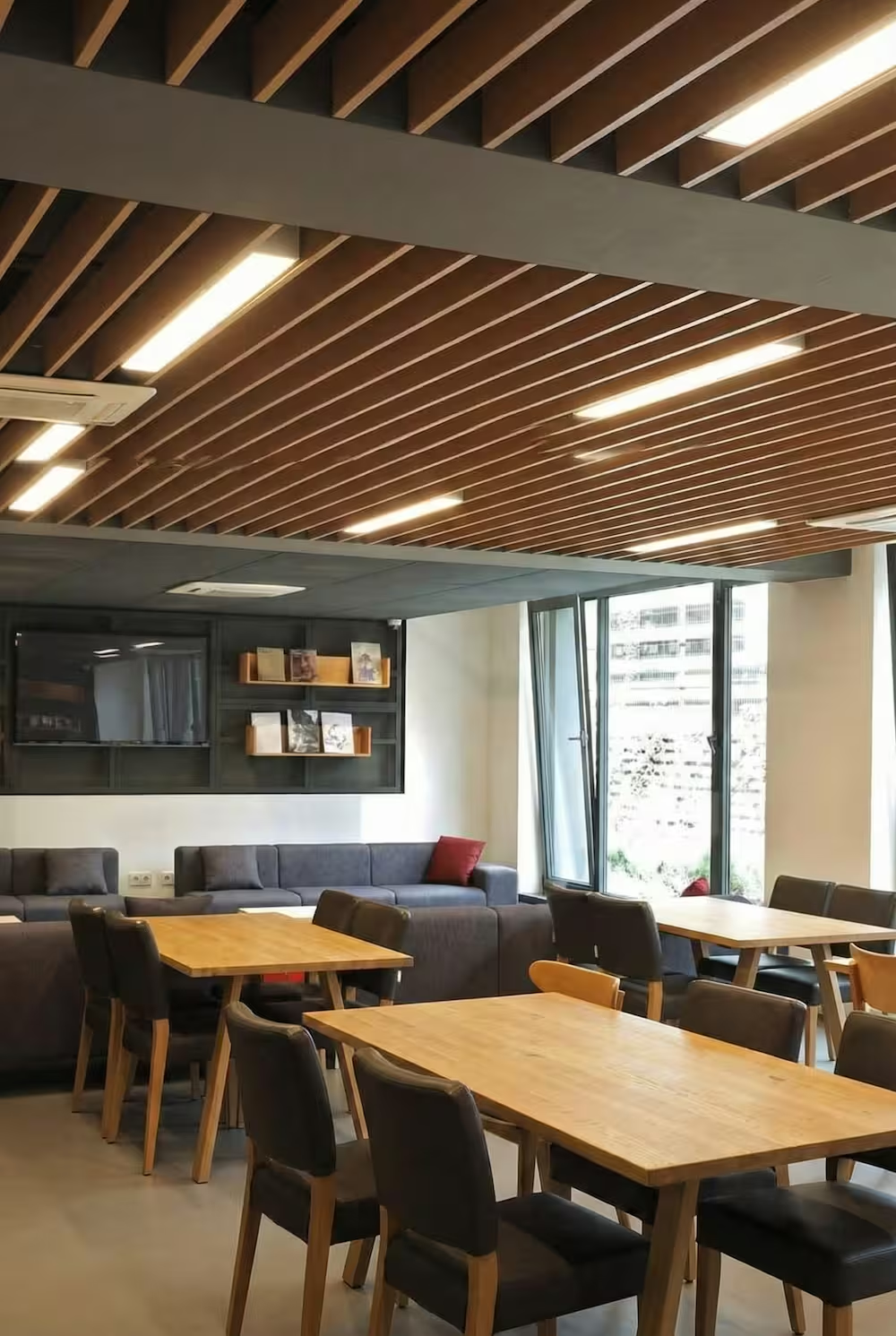
1. Ceiling absorption to bring RT60 down to target. The ceiling is almost always the largest unobstructed surface in a classroom, it’s not occupied by furniture or students, and treating it disrupts teaching the least. Acoustic ceiling tiles, baffles, or a suspended acoustic cloud sized against the room’s actual measured RT60 (not a guess) typically closes most of the gap to the ≤ 0.6 s target on its own. We go deeper on how to size and prioritize ceiling treatment specifically in ceiling vs. wall acoustic treatment — read that before specifying products, because ceiling and wall absorption aren’t interchangeable and the wrong mix wastes budget.
2. Wall absorption, prioritizing the rear and side walls. Where ceiling coverage alone doesn’t close the gap — or where late reflections off a hard back wall are specifically bouncing sound back toward students who already have the weakest direct signal from the teacher — targeted wall panels at the back and sides of the room address the specific geometry causing back-row intelligibility loss. This is also where flutter echo between parallel hard walls typically gets solved.
3. Control HVAC and background noise toward ≤ 35 dBA. A perfectly treated room for reverberation can still fail on signal-to-noise ratio if the ventilation system, an old projector fan, or an unsealed duct run is adding a constant noise floor. This is a mechanical-engineering and acoustic-engineering problem together — quieter equipment selection, duct sizing/silencers, and vibration isolation — and it’s frequently the item schools underestimate because it doesn’t “look” like an acoustic problem the way an echoey room does.
4. Sound insulation to adjacent rooms and corridors. If the complaint is specifically about hearing the class next door, the gym, or corridor traffic rather than the room’s own acoustics, that’s a different discipline: mass, sealed assemblies, and door/glazing quality, not absorption. Absorption reduces reverberation inside a room; it does nothing to stop sound transferring through a partition. See ceiling sound insulation and wall sound insulation for that separate service line, and sound insulation and building regulations for how insulation requirements are typically codified alongside reverberation standards like ANSI S12.60 and BB93.
5. Layout. Where budget or building constraints limit treatment, seating layout, teacher positioning, and even something as simple as which wall the whiteboard sits against can meaningfully change how much unusable, doubly-reflected speech reaches the back of the room. Layout is never a substitute for treatment where the room genuinely fails its RT60 or noise target, but it’s a real, no-cost lever worth using alongside physical treatment.
Where This Connects to Speech Intelligibility Directly
Everything above is really in service of one number: how intelligible the teacher’s speech is by the time it reaches a student’s ear, wherever they’re sitting. The formal metric for that is the Speech Transmission Index (STI) — the same 0–1 intelligibility scale used to assess meeting rooms, auditoriums, and public-address systems, where anything above roughly 0.75 is considered excellent and below 0.45 is considered poor. We explain how STI is measured and what drives it up or down in speech intelligibility (STI) in meeting rooms; the physics transfers directly to classrooms, since both are speech-first, RT60-and-noise-sensitive spaces. If you take one thing from that connection: RT60 and background noise aren’t ends in themselves — they’re the two levers that move STI, and STI is what actually determines whether a student at the back row understands the lesson or just hears noise shaped roughly like a sentence.
Realistic Expectations and Budgeting for Schools
We set the same expectations with school facility teams that we set with any client, because overpromising helps no one:
- Absorption fixes reverberation, not everything. Ceiling and wall absorption will reliably bring RT60 down to target in the great majority of classrooms — but if the complaint is really about noise transferring into the room from a corridor, a mechanical plant room, or the class next door, absorption alone won’t solve it. That needs a sound-insulation assessment as well, and it’s worth diagnosing both at the survey stage rather than treating once, discovering the complaint persists, and having to come back.
- Retrofits are almost always cheaper than expected relative to a full renovation. Ceiling treatment, in particular, is typically installed without touching the existing suspended grid, structural work, or occupying the room for more than a normal school holiday window — it doesn’t require the disruption budget-holders often assume.
- Prioritize by room, not by building. Not every classroom in a school performs equally badly — rooms with hard, parallel walls, high ceilings, glazed partitions, or a location next to a noisy mechanical space or gym are reliably the worst offenders. A phased plan that treats the worst rooms first, verified by measurement, gets the most improvement for a limited first-year budget rather than spreading a thin layer of treatment across every room at once.
- Measure before and after. Specifying panels by eye or by product marketing claims (a common source of underperforming installs) is a false economy. We measure RT60 and background noise per room before scoping treatment, size the fix to the actual gap against ANSI S12.60 or BB93, and re-measure after installation to confirm the room actually lands in range — not just that panels went up.
- Budget for the whole problem, not just the visible symptom. A room that sounds “echoey” is easy to justify treating. A room that’s simply a bit too noisy from HVAC, with no obvious echo, is just as much of a comprehension problem for students but gets deprioritized far more often because it’s less obviously “acoustic” to a non-specialist walking through. Both belong in the same scope.
Request a Classroom Acoustic Survey
If teachers in your building are raising their voices by mid-morning, students at the back of the room have checked out, or you’ve had parent complaints about a specific classroom, the fastest way to know exactly what’s driving it — and what it will actually take to fix — is a measured survey rather than a guess. Our team measures RT60 and background noise per classroom against the ANSI S12.60 / BB93 targets, identifies whether the problem is reverberation, background noise, sound transfer from adjacent spaces, or a combination, and designs a treatment plan sized to the real gap rather than a generic panel package. Request a site survey or acoustic measurement for your school, and we’ll walk you through what we find room by room and a realistic, prioritized plan to fix it.

FAQ
Why can’t students hear the teacher even when the room seems quiet?
Because “quiet” as an adult perceives it and “quiet enough for a child to reliably understand speech” are different thresholds. A room can be free of obvious loud noise and still have a reverberation time above the 0.6 s classroom target, which smears consonants together, or a background noise floor above the 35 dBA target from HVAC or nearby rooms, which erodes the signal-to-noise ratio children need. Both are frequently present without sounding dramatically loud to an adult visitor.
What reverberation time should a classroom have?
ANSI/ASA S12.60 requires core teaching spaces up to 283 m³ to have a reverberation time of 0.6 seconds or less, with a slightly more lenient 0.7 s allowed for larger rooms (283–566 m³). BB93 in England sets a comparable ~0.6 s target for new-build teaching spaces. Ancillary spaces like gyms and corridors have a background-noise limit but no formal RT requirement, because they aren’t used for instruction.
Is classroom noise really linked to reading and literacy outcomes?
Yes. Poor classroom acoustics — long reverberation and high background noise together — measurably reduce speech intelligibility, and children, English-language learners, and students with even mild hearing loss are disproportionately affected because they have the least capacity to fill in missed words from context. This shows up directly in comprehension and early literacy tasks that depend on distinguishing similar-sounding sounds and words.
What’s the single most cost-effective fix for a noisy classroom?
In most rooms we survey, ceiling absorption delivers the largest improvement in reverberation time per dollar spent, because the ceiling is the largest unobstructed surface and treating it doesn’t disrupt furniture, seating, or teaching. It should be sized against the room’s actual measured RT60, not selected by product marketing claims, and is typically installable without a full renovation.
Does classroom acoustic treatment stop noise coming from the corridor or the class next door?
No — that’s a separate problem. Ceiling and wall absorption control reverberation inside the room; they don’t meaningfully block sound transferring through a partition, door, or shared ceiling plenum from an adjacent space. If the complaint is specifically about hearing another room, that needs a sound-insulation assessment of the wall, door, and flanking paths, not (only) absorption treatment.
Can a sound-field or voice-amplification system replace acoustic treatment?
It can help as an interim measure — raising the teacher’s effective signal level for students in poor listening positions — but it doesn’t address the underlying reverberation or background noise causing the problem, and amplifying speech into a highly reverberant room can make intelligibility worse, not better, by amplifying the reflections along with the direct voice. We treat amplification as a supplement to a properly treated room, not a substitute for hitting the RT60 and background-noise targets.
Designing silence for real spaces.
Offices, hotels, restaurants, schools and healthcare — measured acoustic solutions, delivered end to end.
