
Is Your Café Too Loud? Balancing Atmosphere, Comfort and Conversation
Is Your Café Too Loud? Balancing Atmosphere, Comfort and Conversation
Yes — most modern cafés are too loud, and it usually isn’t the customers’ fault. A small room finished entirely in tile, glass, concrete and exposed ceiling has almost nowhere for sound to go, so an espresso grinder, a milk wand and a dozen conversations pile up into a wall of noise within minutes of opening. The fix is rarely “turn the music down” — it’s adding enough sound absorption to bring the room’s reverberation time down to around 0.6 seconds, in a way that fits the café’s look and budget.
Cafés occupy a strange acoustic middle ground. They are usually smaller than restaurants, so in theory they should be easier to control. In practice, they are often worse, because the design language of the modern café — minimalist, industrial, all hard surfaces, no tablecloths, no carpet, no drapes — removes almost every material that would naturally absorb sound. Add a espresso machine that hisses and grinders that shriek at close range, and a room that seats 20 people can feel louder than a restaurant seating 100.
In this guide we’ll unpack why small hard cafés get so fatiguing, what “too loud” actually means in measured terms, where the noise is coming from, and how to fix it without turning your café into a hushed, sterile space — because a café with zero energy isn’t the goal either. This article focuses on treating sound inside the room (absorption and reverberation). If your issue is noise escaping to neighbours or a residential unit above, that’s a different discipline — sound absorption vs. soundproofing explains why the two are not interchangeable.
Why is my café so loud even though it’s small?
Room volume and reverberation time are related, but not in the way most owners assume. A big room with a lot of surface area has more opportunity to absorb sound simply because there’s more surface to treat. A small café, by contrast, often has a low ceiling, hard walls close to every table, and a tile or polished-concrete floor — so sound reflects back to listeners’ ears almost immediately, with very little distance for it to lose energy. The result is a short path length but a long decay time, because nothing along that short path is absorbing anything.
This is why our reverberation time and RT60 target for dining and café spaces sits at 0.6–1.0 seconds, with the ideal for smaller rooms nearer the bottom of that range, around 0.6 s. A 40-seat café with 3.5 m ceilings, glass frontage, tiled floor and an open industrial ceiling can easily measure 1.3–1.8 seconds of RT60 — two to three times longer than it should be. That gap is what people describe as the room feeling “boomy,” “echoey,” or simply exhausting after twenty minutes.
The physics is described by the Sabine formula: RT60 = 0.161 × V / A, where V is room volume in cubic metres and A is total absorption in metric sabins (surface area × absorption coefficient, summed across every surface). In a café stripped of soft materials, A is tiny relative to V, so RT60 climbs — regardless of how “small” the room feels to a customer walking in.
What does “too loud” actually sound like in numbers?
Using the same measurement framework as full-service dining, café noise typically falls into these bands:
| Condition | Typical sound level | Customer experience |
|---|---|---|
| Off-peak, few tables occupied | 45–55 dB(A) | Comfortable, easy to work or talk |
| Mid-morning/lunch rush, moderate occupancy | 65–72 dB(A) | Noticeable buzz, still manageable |
| Peak rush, untreated hard interior | 75–85 dB(A) | Diners raise voices, laptop workers give up, baristas shout order numbers |
These are the same reference bands used in our companion piece on ideal reverberation time for restaurants and cafés. Above roughly 80 dB(A), the Lombard effect kicks in — people unconsciously raise their voice to be heard over the ambient noise, which raises the ambient noise further, which makes people raise their voices again. In a small, hard-surfaced café this feedback loop compounds quickly because there’s so little absorption to slow it down. It’s genuinely possible for a 40-seat café at 80% capacity to be louder, table-for-table, than a poorly treated 150-seat restaurant, simply because the reflective surface area per customer is so much higher.

Where is the noise actually coming from?
In our site surveys of cafés, the sources tend to fall into a short, repeatable list — and most owners are surprised how much comes from equipment rather than people.
- Espresso machines and grinders. A commercial grinder can produce sharp, high-frequency noise in the 70–90 dB(A) range at close distance — brief, but frequent, and often positioned right at the counter where staff and the nearest tables sit.
- Steam wands and portafilter knocks. Repetitive impulsive noise (the knock-box, the tamp, the steam purge) that’s rhythmic rather than constant, but adds up over a service.
- Chatter reflecting off hard surfaces. The core reverberation problem — conversation, once it leaves a table, bounces off tile, glass and bare ceiling repeatedly before it decays, raising the background “roar” that every other table then has to talk over.
- Music systems, often turned up to compensate. Once ambient noise rises, staff instinctively raise the music volume to maintain “atmosphere,” which raises the baseline further — a second feedback loop stacked on top of the Lombard effect.
- HVAC and refrigeration units, particularly in cafés with open kitchens or exposed condenser units, adding a constant low hum that raises the noise floor even when the room is quiet.
- Door and street noise in cafés with frequently opening glass doors or streetside seating bleeding through to indoor tables.
The first three (equipment, impulsive noise, and chatter reflection) are almost always the dominant factors, and they are also the ones acoustic treatment addresses directly. For a broader breakdown of noise sources across food-service venues generally, see how to reduce restaurant noise — the same root causes apply to cafés, just concentrated into a smaller footprint.
Why do laptop workers and conversationalists both complain — even though they want opposite things?
Cafés serve two customer types simultaneously, and a bad acoustic environment fails both at once:
- Focus workers need enough quiet to concentrate — not silence, but a background that doesn’t spike unpredictably with grinder noise and shouted order numbers. Intermittent, high-amplitude bursts (a grinder cycling, a milk wand hissing) are more disruptive to concentration than steady ambient noise, because they force repeated attention resets.
- Conversational customers need to be able to hear the person across the table without straining or leaning in. Once background level and reverberation rise past a certain point, two people at a table have to raise their voices to maintain intelligibility — which then raises the background for the table next to them.
Interestingly, the fix for both groups is the same: reduce reverberation and control equipment noise at the source. You are not choosing between “quiet café for laptops” and “lively café for conversation” — a well-treated café supports both, because it lowers the noise floor that both a focused worker and a chatting pair have to fight against. What you are trading against is total silence: a café with an RT60 near 0.6 s and moderate occupancy still has energy and buzz, which is the point — see the section below on realistic expectations.
What actually fixes café noise, and does it clash with the design?
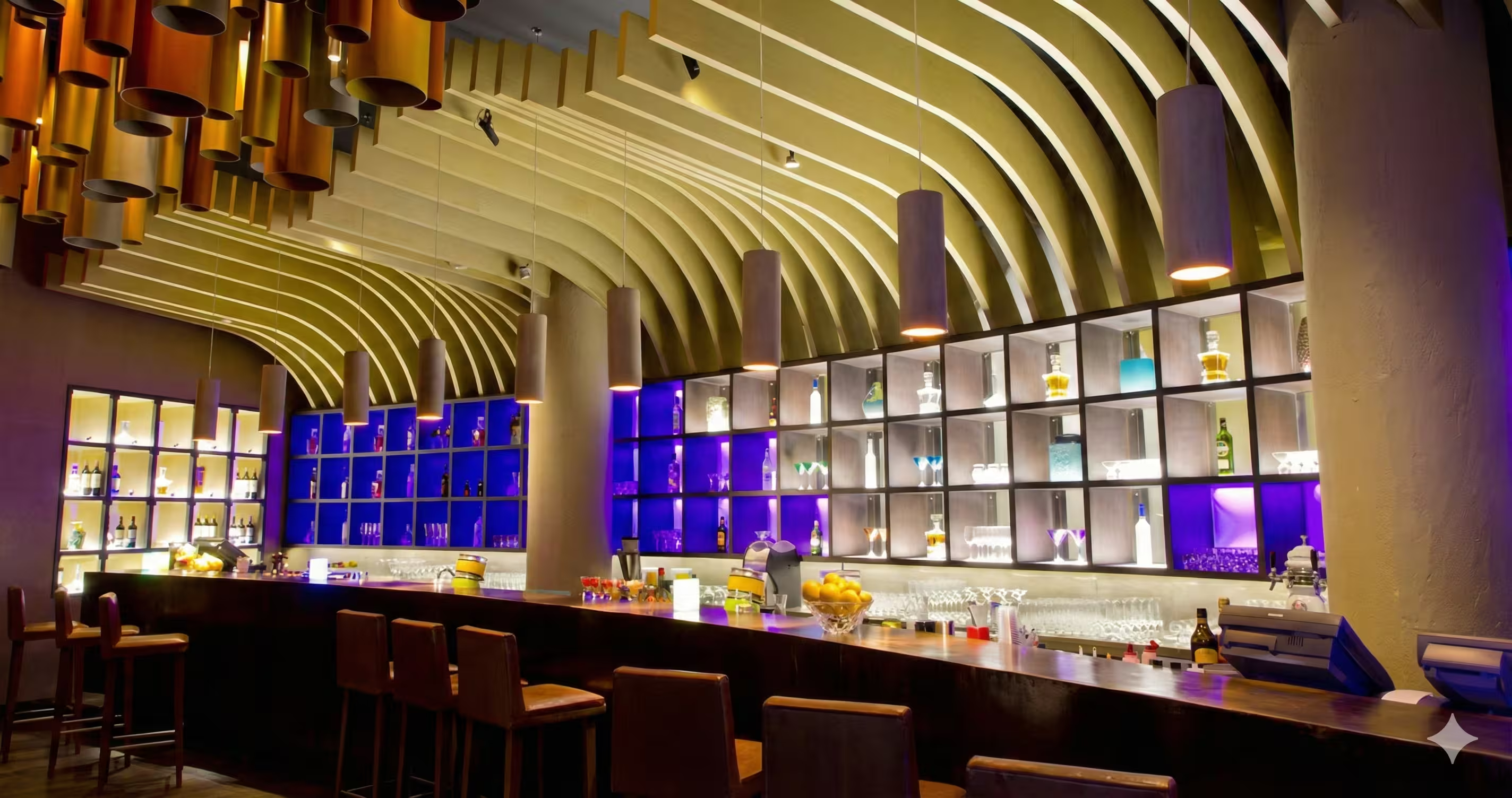
This is the part café owners worry about most — that acoustic treatment means foam panels and carpet tiles that will ruin a carefully designed minimalist interior. It doesn’t have to. The lever that matters most is ceiling absorption, precisely because a café ceiling is large, usually unbroken by furniture, and (in most builds) the least design-critical surface in the room.
| Noise source | Typical fix | Design impact |
|---|---|---|
| Reflective ceiling (concrete/exposed structure) | Suspended acoustic baffles, felt ceiling clouds, or a fully absorptive ceiling rated for NRC 0.80+ | Can be a design feature (color, shape) rather than a compromise |
| Hard walls, especially opposite the counter | 3–6 decorative acoustic panels, felt wall art, upholstered banquette backs | Panels available in fabric, wood-slat or printed finishes to match branding |
| Bare tables/hard seating amplifying local chatter | Upholstered bench seating, soft armchairs in at least part of the floor plan | Softens a portion of the room without changing the whole aesthetic |
| Espresso machine/grinder noise at the counter | Relocate grinder away from the nearest seating; add an absorptive panel or baffle directly behind/above the counter | Localized fix, doesn’t touch the dining floor |
| Music compensating for noise (feedback loop) | Set and cap music level once reverberation is controlled, rather than raising it to mask chatter | No design impact — an operational policy change |
| General “boominess” and echo across the whole room | Combination of ceiling + a portion of wall coverage, calculated to hit ~0.6 s RT60 for the specific room volume | Sized to the room via calculation, not guesswork |
The reason we start with a calculation rather than “add panels until it sounds better” is that a small café over-corrected with soft treatment can end up too dead — flat, lifeless, with no ambient energy at all, which some owners dislike as much as the original noise. Sizing the absorption to the room’s actual volume (using the same Sabine relationship above, worked backward from a 0.6 s target) avoids both failure modes. This is the same reasoning behind ceiling vs. wall acoustic treatment — ceiling absorption typically delivers more reverberation reduction per square metre than wall panels because it isn’t broken up by furniture, art, or doors, and it’s directly in the reflection path between the noise sources at counter height and the ears of everyone in the room.
How much absorption is “enough” — and how is it specified?
Not all absorptive-looking materials perform the same. This is where the Noise Reduction Coefficient (NRC) becomes useful: it’s a single 0–1 number, the arithmetic average of a material’s absorption coefficient at 250, 500, 1000 and 2000 Hz (rounded to the nearest 0.05), tested under ASTM C423. An NRC of 0.85 means the material absorbs roughly 85% of the mid-frequency sound striking it; a wall of glass or polished concrete sits near 0.00–0.05.
Two things matter here that owners often miss:
- NRC is a coarse average, not the full story. A thin decorative felt panel might carry a respectable NRC on the label but absorb almost nothing at the low frequencies that make a room feel “boomy” versus the mid/high frequencies that make it feel “clangy.” For a full breakdown of what NRC does and doesn’t tell you, see NRC vs. sound absorption coefficient.
- Coverage matters as much as coefficient. Six beautiful acoustic panels on one feature wall will not fix a 60 m² café with a 4 m ceiling. The amount of absorptive area required is a function of room volume, not room “vibe” — which is exactly why we calculate it per room rather than quoting a standard panel count.
The business case: why acoustic comfort keeps regulars coming back
Café economics run on dwell time and repeat visits more than any other food-service format — a customer who lingers over a second coffee, opens a laptop, or brings a meeting there is worth more over a year than one who is driven out by the noise after ten minutes. The same research base behind restaurant noise complaints applies directly: noise is consistently ranked among diners’ and customers’ top complaints, and roughly 80% of UK survey respondents report leaving a venue early or avoiding a return visit because of noise. Cafés depend disproportionately on repeat, habitual customers — the person who comes in three times a week — and that habit is exactly what a fatiguing acoustic environment erodes first, because it’s the difference between “I can work here” and “I can’t think in here.”
There’s a second, quieter cost: staff. Baristas and counter staff spend entire shifts inside the loudest part of the room, next to the grinder and steam wand, absorbing the same reverberant buildup as customers but for eight hours instead of thirty minutes. Vocal strain from shouting over the noise and general shift fatigue are common, under-discussed costs of an untreated counter area.
Setting realistic expectations: a café isn’t a library
It’s worth being direct about what acoustic treatment will and won’t do. A café is a social, commercial space — some ambient buzz is part of the appeal, and a completely dead room (RT60 well under 0.5 s) can feel sterile and kill the atmosphere that makes people want to linger in the first place. The goal for most cafés is around 0.6 s, not silence. Treatment reduces the reverberant buildup — the reflections that compound chatter and equipment noise into a wall of sound — it does not, and is not meant to, eliminate the sound of a busy counter or a full room of conversation. If your primary complaint is noise transferring to an apartment upstairs or a shared wall with a neighbouring tenant, that’s a sound-insulation problem, not a reverberation one, and needs a different assessment — see airborne vs. impact noise for the distinction.
How we approach a café acoustic project
Every café we survey is different in layout, volume, and finish, so our process starts with measurement rather than assumption:
- On-site measurement of existing RT60 and peak/typical sound levels during service, mapped against the ~0.6 s target for the room’s actual volume.
- Identify dominant noise sources — counter equipment, ceiling geometry, glass frontage, HVAC — since the treatment plan differs depending on which one dominates.
- Model the required absorption (ceiling first, wall second) using the Sabine relationship, sized to the room, not a generic panel count.
- Select materials and finishes that meet both the acoustic target and the café’s branding — fabric-wrapped panels, felt clouds, printed baffles, or upholstered seating, chosen alongside the design team rather than instead of it.
- Install and re-measure to confirm the room has actually moved toward the target, rather than assuming the fix worked because it “sounds better” anecdotally.
This mirrors the general workflow described in what a professional acoustic survey includes and how acoustic measurement is performed — the same methodology, scaled to a smaller room.
Ready to find out how loud your café actually is?
If regulars are commenting on the noise, staff are going hoarse by 2pm, or you’ve noticed laptop customers quietly stop coming back, the first step isn’t buying panels — it’s measuring the room. Our team can carry out an on-site acoustic survey of your café, measure your current reverberation time and peak sound levels, and model exactly how much ceiling and wall absorption would bring you back toward a comfortable, lively — but not exhausting — 0.6 second target. Request a site survey or acoustic measurement and we’ll walk you through what a fix would look like for your specific space and budget. You can also browse our café acoustics service page or the broader room acoustics and restaurant acoustics pages for related project examples.
Frequently Asked Questions
Why is my café louder than restaurants three times its size?
Because reflective surface area per customer, not room size, drives reverberation. A small café finished entirely in tile, glass and exposed concrete has almost no absorption to slow reflections down, so noise builds up faster and closer to every table than in a larger room with even modest soft furnishing. The relevant metric is reverberation time (RT60), not floor area — see what is reverberation time (RT60).
What’s the ideal reverberation time for a café?
Around 0.6–1.0 seconds, with smaller cafés targeting nearer the bottom of that range, close to 0.6 s. Untreated modern café interiors commonly measure 1.3 seconds or more, roughly double the target.
Will acoustic panels ruin my café’s minimalist look?
Not if sized and specified correctly. Ceiling absorption (felt clouds, baffles) is often the single highest-impact fix and can be designed as a visual feature rather than a compromise. Wall panels can be finished in fabric, wood-slat or printed designs that match branding rather than looking like generic foam.
Is the espresso machine and grinder actually a big part of the problem?
Yes — grinders in particular can produce sharp, high-frequency noise up to 90 dB(A) at close range, and because the counter is usually close to the nearest seating, that noise reaches customers at near-peak level repeatedly through a shift. Relocating equipment slightly and adding localized absorption behind the counter is often a quick, high-value fix alongside the room-wide treatment.
Should I just turn the music down instead of treating the room?
Turning music down helps, but it doesn’t fix the underlying reverberation problem — chatter and equipment noise will still build up and reflect the same way. Worse, once ambient noise is high, staff tend to raise music to compensate, which adds to the problem rather than solving it. Treating the room first, then setting a fixed music level, breaks that feedback loop.
How is café acoustic treatment different from soundproofing?
Acoustic treatment (absorption) controls how sound behaves inside the café — reverberation, echo, buildup of chatter and equipment noise. Soundproofing (sound insulation) controls how much noise passes through walls, floors or ceilings to neighbouring units. A café can need one, the other, or both — see sound absorption vs. soundproofing for the full distinction.
Designing silence for real spaces.
Offices, hotels, restaurants, schools and healthcare — measured acoustic solutions, delivered end to end.